

Trucking Industry Outlook
Trucking Industry Outlook: What Fall 2026 Looks Like for Carriers and Shippers
The trucking industry outlook for fall 2026 points to one dominant theme: capacity is tight, and it’s staying that way. We covered the start of this shift back in Freight Rates Are Rising in 2026 and gave a monthly snapshot in Trucking Industry News July 2026 — the short version is that after nearly four years of a soft, oversupplied freight market, 2026 turned into a structural transition year. As harvest season ramps up across the Midwest, Pacific Northwest, and Southeast, that tightness is about to get tested harder than it has in years.
For produce shippers, agricultural carriers, and the brokers who serve them, understanding what’s driving this shift isn’t optional. It’s the difference between locking in capacity at a fair rate and scrambling for a truck during the busiest six weeks of the year.

Elite Logistics provides dependable freight transportation through every road and every season. Call 406-600-2928.
Capacity Is Tighter Than Demand Alone Would Suggest
Freight volumes haven’t exploded in 2026 — they’ve stayed relatively flat compared to last year. What’s changed is the supply side. Acute capacity tightness, driver scarcity, regulatory enforcement, and limited fleet expansion have combined to support substantially higher truckload rates, even without a broad-based surge in freight demand. Spot rates excluding fuel were running roughly 43% higher year over year by mid-summer, with contract rates up around 13%, signaling the rate strength is extending well beyond short-term spot disruption.
Spot truckload rates have actually moved above contract rates for the first time since 2021, and tender rejection rates — a key measure of how often carriers turn down freight — have climbed to their highest levels since 2022, meaning carriers have more leverage and more freight options than they’ve had in years. We broke down what this kind of capacity squeeze means for shippers directly in The 2026 Trucking Industry Crisis, and it’s a big reason tight capacity is also translating into more missed pickups — see Why Freight Shipments Get Delayed for what that looks like on the ground.
The driver shortage is a big part of the story. After a four-year bottoming phase in the for-hire cycle, the industry has moved into an early-cycle phase where capacity has become genuinely short, and a new driver shortage — the third in the past decade — is pushing rates higher. Regulatory enforcement is compounding it: stricter enforcement around English-language proficiency standards and non-domiciled drivers is an upside risk that could tighten capacity even further as the year goes on.
For carriers who’ve stayed disciplined through the downturn, this is the payoff. For shippers, it means fall 2026 is not the season to wait until the last minute to book capacity.
Reefer and Produce Freight: Peak Season Meets Peak Tightness
Refrigerated capacity has been under sustained pressure all year, and it isn’t easing up as harvest season moves north and east. Reefer spot rates excluding fuel rose to about $2.69 per mile by June, up 39% year over year, and continued to run ahead of normal seasonal patterns into July — with spot rates moving above contract rates for the first time since February 2022, a sign of real near-term capacity strain.
C.H. Robinson raised its 2026 refrigerated truckload cost-per-mile forecast again in July, citing continued carrier capacity tightening, and now expects refrigerated van cost-per-mile to run about 35% higher year over year for the full year. That pressure isn’t confined to the traditional spring produce belt anymore. The Pacific Northwest is entering a period of increasing seasonal pressure as cherry and onion harvests accelerate, and refrigerated capacity has tightened as additional crops come online in the months ahead — a pattern that’s pulling equipment toward the Upper Midwest as harvest activity expands there too. We dug into how shifting water availability is reshaping that whole harvest calendar in What Water Cutbacks Mean for Shippers.
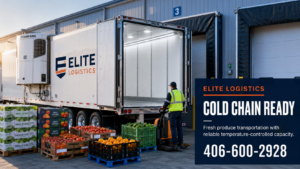
Elite Logistics provides cold-chain-ready transportation for fresh produce and other temperature-sensitive freight. Call 406-600-2928.
Historically, October has been the strongest rate month of the year across nearly every equipment type, as Midwest grain harvest, holiday import volume, and retail restocking all converge on the same limited pool of trucks at once. If you’re evaluating carriers for this stretch, our guides on how to choose a produce trucking company and produce trucking temperature requirements cover the vetting details worth checking before you commit a season’s worth of loads to one carrier. Elite Logistics runs dedicated produce trucking and refrigerated trucking service lines built around exactly this kind of seasonal pressure.
Diesel Prices Remain a Wildcard
Fuel costs have been anything but predictable in 2026. The national average price for on-highway diesel jumped from roughly $3.90 to $4.86 per gallon during the first week of March — a 96-cent, 25% increase in a single week, the largest weekly jump the EIA has recorded since it began tracking the series in 1994. That surge pushed the EIA to revise its full-year 2026 diesel forecast upward to about $4.12 per gallon, well above the roughly $3.43 originally projected. By mid-summer, the EIA put the national average diesel price at $4.796 for the week ending July 13, 2026 — still below the $5.50-plus spikes of mid-2022, but firmly above the sub-$3.00 levels of 2019-2020.

Elite Logistics keeps freight moving with reliable transportation solutions. Call 406-600-2928.
For carriers and shippers alike, that means fuel surcharge programs matter more this fall than they have in years. If you want the full breakdown of how a freight invoice is actually built — line-haul, fuel surcharge, accessorials, and where shippers typically overpay — see Freight Shipping Rates and Costs. Locking in rate structures that account for fuel volatility, rather than assuming flat costs, is the more resilient move heading into Q4.
Cargo Theft Is Accelerating — And Produce Is a Target
This is one of the fastest-moving risks in trucking right now, and it’s directly relevant to anyone shipping high-value agricultural freight. U.S. and Canada cargo-theft losses hit a record of roughly $725 million in 2025, a 60% jump from about $455 million in 2024, with the average theft now topping $273,990 — up 36% in a single year.
The bigger shift is in how freight is being stolen. Strategic theft — using deception, fraud, and cybertheft to trick shippers, brokers, and carriers into handing loads directly to thieves instead of legitimate receivers — has skyrocketed 1,500% since 2022. Deceptive or fictitious pickups alone increased 31% year over year as of Q1 2026, with criminals now as likely to show up with a laptop as a crowbar. The FBI has confirmed cyber threat actors are gaining unauthorized access to broker and carrier systems — through spoofed emails, fake URLs, and compromised accounts — then posting fraudulent loads on load boards to redirect real freight away from its intended destination. We covered the mechanics of these schemes and how to defend against them in detail in Freight Theft in 2026.
Secure freight, protected capacity, and dependable transportation solutions from Elite Logistics. Call 406-600-2928.
For produce and perishable freight specifically, the exposure is real: agricultural products are explicitly called out among the goods most often reintroduced into the supply chain after theft, and time-sensitive loads make an easy target for fictitious-pickup schemes. Verifying driver identity, MC numbers, and pickup credentials before releasing a load — not after — is no longer optional.
What This Means Heading Into Q4
Put together, fall 2026 looks like a market where:
- Rates are firming, not falling. Both dry van and reefer spot rates are running above seasonal norms, and October’s historical status as the highest-rate month of the year is likely to hold.
- Capacity is scarce, not abundant. Driver shortages and regulatory enforcement are constraining supply faster than demand is growing, which means shippers who wait to book loads will pay more for what’s left.
- Fuel costs need active management. Diesel volatility this year has been extreme enough that fixed-fuel assumptions in contracts are a real risk.
- Security has to be built into the process. Strategic theft is growing faster than any other category of cargo crime, and produce shippers are squarely in the crosshairs.
If you’re weighing which trailer type fits your fall freight, Dry Van vs. Reefer vs. Flatbed is a good place to start. For agricultural shippers working with a carrier that understands cold-chain timing, verifies every pickup, and plans routes around regional harvest windows, this fall is manageable. For shippers without that kind of partner, it’s going to be an expensive season.
Frequently Asked Questions
Are freight rates going up in fall 2026?
Yes. Both dry van and reefer spot rates have been running above normal seasonal patterns through mid-2026, driven by tightening capacity rather than a surge in demand. Most forecasters expect that trend to continue into Q4.
Why is reefer capacity so tight right now?
A combination of driver shortages, an aging refrigerated trailer fleet, and overlapping harvest seasons across California, the Pacific Northwest, and the Midwest is straining the available pool of temperature-controlled trucks at the same time demand for cold-chain freight is highest.
What’s driving the driver shortage in 2026?
Stricter enforcement of English-language proficiency requirements and rules affecting non-domiciled CDL holders has removed a portion of the existing driver pool, while new driver entry hasn’t kept pace — pushing the industry into its third driver shortage of the past decade.
How much has diesel changed in 2026?
Diesel prices spiked nearly 25% in a single week in early March 2026 — the largest weekly increase on record — and have remained elevated since, running close to $4.80 per gallon through mid-summer.
What is strategic cargo theft, and why does it matter for produce shippers?
Strategic theft uses fraud, impersonation, or cyberattacks to trick a shipper, broker, or carrier into handing a load directly to a thief instead of the legitimate receiver. It’s grown 1,500% since 2022 and is a particular risk for time-sensitive, high-value produce loads where verification steps sometimes get rushed to meet delivery windows.
When is peak freight season in fall 2026?
October is historically the highest-rate month of the year across nearly every equipment type, as Midwest grain harvest, holiday import volume, and retail restocking all compete for the same limited truck capacity simultaneously.
Should shippers lock in contract rates or use the spot market this fall?
With spot rates running above contract rates in several markets, locking in contract capacity ahead of peak season is generally the more stable option for shippers who need guaranteed pickups, while carriers with flexibility may find better returns chasing spot freight in tight lanes.
This post was researched using current freight market data from ACT Research, C.H. Robinson, the U.S. Energy Information Administration, Verisk CargoNet, and the FBI’s Internet Crime Complaint Center, current as of August 2026.