
Our Blogs
Explore expert tips, industry updates, and practical advice to make smarter logistics decisions.
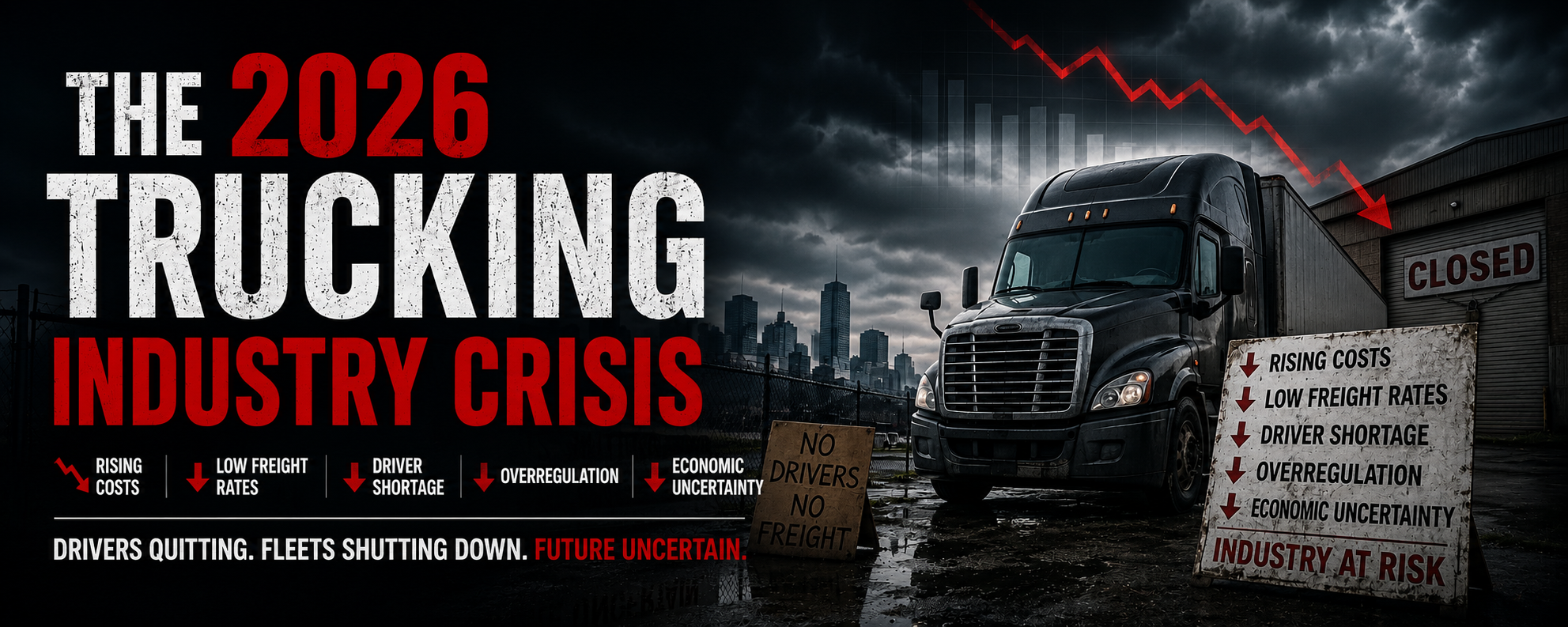
The 2026 Trucking Industry Crisis
The 2026 Trucking Industry Crisis — And Why Your Freight Carrier Partner Has Never Mattered More
The The 2026 Trucking Industry Crisis is facing a perfect storm: a driver shortage that could reach 174,000 by year-end, freight spot rates that have surged 18–23% in the past twelve months, and sweeping FMCSA regulatory changes that are quietly shrinking available carrier capacity. For businesses that depend on freight — whether you’re shipping produce, heavy equipment, or time-sensitive hot shot loads — who you trust to move your cargo has never been a more important decision.
The 2026 Trucking Landscape by the Numbers
After years of post-pandemic volatility, many shippers expected 2026 to bring stability. Instead, the market is entering a new cycle of constraint — one driven not just by economics, but by policy, demographics, and regulation converging at once. The data tells a stark story.
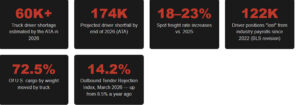
The 2026 Trucking Industry Crisis by the numbers: a 60,000+ driver shortage, freight rates up 18–23%, and 122,000 driver positions quietly erased from industry payrolls since 2022. The Outbound Tender Rejection Index hit 14.2% in March 2026 — nearly double the rate from a year ago. Sources: ATA, BLS, DAT Freight & Analytics, Freight Waves SONAR, 2026.
These numbers represent real-world consequences: loads being rejected at the last minute, lanes tightening, and businesses across every sector scrambling to lock in reliable carrier relationships before conditions deteriorate further.
The Truck Driver Shortage: Deeper Than Anyone Realized

The 2026 Trucking Industry Crisis: New FMCSA rules removed nearly 3,000 CDL training providers and restricted eligibility for non-domiciled license holders — shrinking available carrier capacity by an estimated 10–15%. Elite Logistics LLC keeps your freight covered. Manhattan, MT | (406) 600-2928
The trucking industry in 2026 is facing a perfect storm: a driver shortage that could reach 174,000 by year-end, freight spot rates that have surged 18–23% in the past twelve months, and sweeping FMCSA regulatory changes that are quietly shrinking available carrier capacity. For businesses that depend on freight — whether you’re shipping produce, heavy equipment, or time-sensitive hot shot loads — who you trust to move your cargo has never been a more important decision.
The truck driver shortage in 2026 isn’t a new crisis — it’s a compounding one. The American Trucking Association (ATA) estimates a current gap of approximately 60,000 drivers, with projections that figure could balloon to 174,000 by year-end. But the real picture may be even more severe. A February 2026 Bureau of Labor Statistics revision revealed that 122,000 driver positions had quietly vanished from payrolls since October 2022 — meaning the industry was significantly smaller than industry groups or policymakers had understood.
Compounding this is the demographic reality: the average U.S. truck driver is approximately 46 years old. The ATA projects the industry must recruit 1.2 million new drivers over the next decade — roughly 120,000 per year — just to replace retirees and keep pace with freight demand. That’s a pace the industry has never come close to achieving.
New FMCSA Rules Are Shrinking the Pool Further & The 2026 Trucking Industry Crisis
Regulatory changes have accelerated the supply squeeze. In late 2025, the FMCSA removed nearly 3,000 training providers from its Training Provider Registry. By February 2026, over 550 additional CDL schools had received proposed removal notices following 1,400+ onsite investigations. That means fewer new drivers entering the pipeline at the exact moment the industry needs them most.
A final rule restricting non-domiciled CDL eligibility — affecting asylum seekers, refugees, and DACA recipients — took effect March 16, 2026. Foreign-born drivers represent nearly one in six truckers in the U.S. Analysts at Clarendon estimate this single rule change could remove 10–15% of available carrier capacity from the market. For small fleets, which represent 92% of all U.S. carriers and operate ten trucks or fewer, the impact is disproportionate.
“With reduced capacity and increased demand, pricing should begin to firm by mid-year 2026 and return to higher levels in 2027 — allowing carriers to earn an acceptable rate of return.” — John Larkin, Clarendon
Freight Rates in 2026: What Shippers Are Paying Now
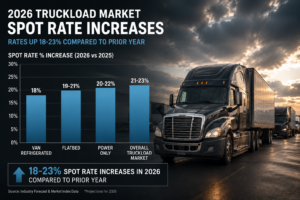
The 2026 Trucking Industry Crisis is hitting shippers’ bottom lines hard: spot freight rates surged 18–23% across all truckload segments compared to 2025 — with flatbed up 19–21%, power only up 20–22%, and the overall truckload market up 21–23%. Locking in a reliable freight carrier now is the smartest move shippers can make. Elite Logistics LLC | Manhattan, MT | (406) 600-2928. Source: Industry Forecast & Market Index Data, 2026 Projections.
Spot rates in the truckload market are up 18–23% compared to a year ago as of mid-2026 (DAT Freight & Analytics). For businesses that locked in long-term contracts during the 2022–2024 freight slowdown, the window has largely closed — renewal increases of 12–18% are now common, with certain high-volume lanes like Texas-to-California or East Coast-to-Florida seeing hikes above 25%.
The Outbound Tender Rejection Index (OTRI) — a key signal of market tightness tracked by Freight Waves SONAR — sat at 14.2% in March 2026, up from 8.5% just one year earlier. When carriers are rejecting a larger percentage of contracted loads, it means they’re finding better-paying freight elsewhere. For shippers, this translates directly to missed pickup windows, last-minute carrier swaps, and premium spot market costs.
The World Trade Organization lowered its 2026 forecast for global merchandise trade growth to just 0.5%, reflecting the dampening effect of new tariffs. While demand is stabilizing rather than booming, the constraint is now firmly on the supply side — which means available capacity, not demand, will drive pricing through the remainder of 2026.
Specialized Freight Is Feeling It Most

Elite Logistics LLC — Long Haul Trucking | Big Loads. Long Hauls. Zero Compromises. Your Freight. Our Priority. | Manhattan, Montana 59741 | 406-600-2928
Not all freight is feeling the squeeze equally. The most acute capacity constraints are concentrated in specialized segments — exactly the services that many Montana businesses, agricultural operations, and industrial shippers depend on most:
Hot shot trucking continues to see growing demand, particularly for time-sensitive pharmaceutical, healthcare, and agricultural deliveries. Qualified hot shot drivers require specialized equipment knowledge and compliance credentials that narrow the available pool further.
Flatbed trucking and heavy haul drivers require additional endorsements and equipment certifications. The qualified pool for these services is estimated to be 60–70% smaller than the general truckload market, making these lanes structurally tight regardless of broader market conditions.
Refrigerated trucking and produce trucking face seasonal demand spikes — particularly in Montana’s agricultural corridors — that routinely outpace available reefer capacity in summer months. In 2026, that mismatch is more pronounced than ever.
When the 2026 trucking industry crisis tightens carrier capacity and drives spot rates up 18–23%, Elite Logistics LLC delivers full-service freight coverage across every load type — hot shot trucking, flatbed, long-haul, heavy haul, refrigerated freight, produce trucking, freight brokerage, and specialized freight. Trinity Logistics partner | USDOT #1480304 | Manhattan, MT | (406) 600-2928.
What Shippers Should Do Right Now
The businesses navigating 2026’s freight market most successfully share a common strategy: they stopped treating carrier relationships as a commodity and started treating them as a strategic asset. Here is what the data — and industry leaders — recommend:
1. Lock In Carrier Relationships Before Rates Climb Further
Shippers still operating on 2024 or early 2025 pricing are finding that window has closed. Working directly with an established, FMCSA-compliant freight carrier rather than relying purely on spot load boards can provide predictable pricing and guaranteed capacity when you need it most.
2. Know Your Lane Requirements in Advance
For long-haul trucking or cross-regional freight, plan further ahead than you did in 2023 or 2024. The market rewards lead time. Last-minute loads are increasingly expensive on the spot market — when coverage can be found at all.
3. Consider a Freight Brokerage Partner
A full-service freight brokerage relationship gives shippers access to an extended carrier network beyond any single fleet — critical when primary lanes tighten or specialized equipment is needed quickly. Elite Logistics LLC operates as both a direct carrier and a Trinity Logistics partner, providing maximum flexibility across load types and destinations.
4. Prioritize FMCSA-Compliant Carriers
Amid stricter CDL enforcement and updated FMCSA Safety Measurement System scoring, the risk of hiring carriers with compliance gaps is rising. Vetting your freight partners for FMCSA compliance isn’t just a best practice in 2026 — it’s protection against service disruptions, liability exposure, and the hidden costs of carrier failure mid-lane.
Why Montana & Nationwide Businesses Trust Elite Logistics LLC
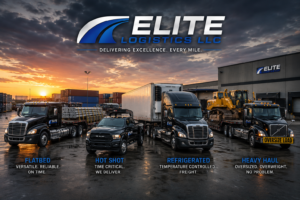
While the 2026 trucking industry crisis drives spot rates up 18–23% and shrinks available carrier capacity nationwide, Elite Logistics LLC stands ready with a full fleet of specialized freight solutions — flatbed trucking, hot shot trucking, refrigerated freight, and heavy haul — all under one roof. Delivering Excellence. Every Mile. Trinity Logistics Partner | USDOT #1480304 | Manhattan, MT | (406) 600-2928
Based in Manhattan, Montana, Elite Logistics LLC has built its reputation on exactly the qualities that matter most in a market like this: reliability, FMCSA compliance, and the breadth of services to handle any load. As a proud Trinity Logistics partner (USDOT #1480304), we combine the reach of a national freight network with the accountability and personal service of a regional carrier.
When capacity tightens across the national trucking market, shippers who have an established relationship with a trusted carrier don’t scramble for coverage — they make a phone call. That’s the difference between a freight partner and a freight vendor.
Frequently Asked Questions
How bad is the truck driver shortage in 2026?
The ATA estimates a current shortage of approximately 60,000 truck drivers, with projections suggesting it could reach 174,000 by year-end. New FMCSA CDL eligibility restrictions that took effect in March 2026 are further shrinking the available driver pool, with some analysts estimating a 10–15% reduction in available carrier capacity.
How much have freight rates increased in 2026?
Spot rates in truckload freight are up 18–23% compared to a year ago (DAT Freight & Analytics, 2026). Shippers renewing contracts are seeing average increases of 12–18%, with high-demand lanes exceeding 25% rate hikes.
What FMCSA changes are affecting trucking capacity in 2026?
The FMCSA removed nearly 3,000 training providers from its Training Provider Registry in late 2025. A March 2026 rule restricting non-domiciled CDL holders took effect, and ongoing enforcement of CDL eligibility changes is removing an estimated 10–15% of U.S. trucking capacity from the market.
What types of freight does Elite Logistics LLC haul?
Elite Logistics LLC offers hot shot trucking, flatbed trucking, long-haul trucking, refrigerated freight, produce trucking, heavy haul, specialized freight, and full freight brokerage services. We serve shippers across Montana and nationwide as a Trinity Logistics partner.
How do I get a freight quote from Elite Logistics LLC?
Call us directly at (406) 600-2928 or email elitelogistics1@outlook.com. You can also request a quote online. We respond promptly to all freight inquiries.

The 2026 Trucking Industry Crisis is expected to create tighter carrier capacity, higher freight rates, and increased competition for reliable transportation. Elite Logistics LLC helps shippers secure dependable freight coverage and maintain supply chain stability throughout changing market conditions.