

The Future of Heavy Haul
The Future of Heavy Haul: Multi-Axle Hydraulic Modular Trailers (SPMTs)
SPMT heavy haul trucking is quickly becoming one of the most talked-about segments of the specialized freight industry. As data centers, wind farms, and industrial plants get bigger and heavier, the equipment needed to move their components is evolving right alongside them. Self-propelled modular transporters — multi-axle hydraulic modular trailers that can carry hundreds of tons with millimeter-level precision — are at the center of that shift.
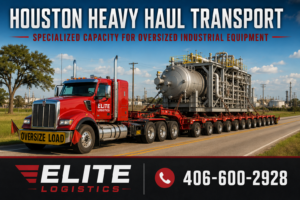
Elite Logistics provides specialized heavy-haul transportation for oversized industrial equipment throughout Houston and the Texas Gulf Coast.
What Is a Self-Propelled Modular Transporter (SPMT)?
A self-propelled modular transporter is a hydraulic platform trailer built on rows of independently powered, steerable axle lines. Unlike a conventional lowboy or step-deck trailer, an SPMT doesn’t need a separate tractor to move — each axle line can carry its own hydrostatic drive unit, and a single hydraulic power pack can steer, lift, and drive an entire string of connected modules.
That design makes the multi-axle hydraulic modular trailer fundamentally different from anything else in general freight. Axles can telescope independently to keep a load level over uneven ground, rotate the entire unit in place, or “crab walk” sideways to thread through tight jobsite clearances. Multiple SPMT units can also be linked lengthwise and side-by-side, essentially building a custom transporter sized to whatever the load requires — whether that’s a bridge girder, a power transformer, or an entire prefabricated building module.
How Multi-Axle Hydraulic Modular Trailers Work
Each axle line on an SPMT functions almost like its own small vehicle. A central control system — sometimes operated from a driver’s cab, sometimes by a technician with a handheld panel — coordinates every axle simultaneously, adjusting height and steering angle in real time to keep the load stable. Because these units are typically hauling the heaviest cargo on wheels anywhere in the industry, they move slowly, often well under a mile per hour when fully loaded, with a ballast tractor sometimes added for extra traction and braking on grades.
The result is precision most conventional heavy haul equipment simply can’t match — critical when a load is worth millions of dollars and clearance on either side is measured in inches, not feet.
Why SPMT and Heavy Haul Demand Is Surging in 2026
Heavy haul trucking is having a moment in 2026, and it’s not a coincidence. Data center construction, renewable energy buildout, and industrial manufacturing expansion are pushing freight dimensions upward across the board — larger wind turbine blades, bigger cranes, and massive prefabricated data center equipment (“e-houses”) are becoming routine loads rather than the exception. Oversized and heavy-haul freight is now commanding some of the highest per-mile rates in all of trucking as a result.
At the same time, capacity for this kind of work is structurally tight. The American Trucking Associations projects a shortage of roughly 82,000 drivers in 2026, and that gap hits specialized segments hardest — heavy haul and flatbed carriers are dealing with a qualified driver pool that’s 60-70% smaller than general truckload because of the extra endorsements, experience, and equipment familiarity the work demands. Fewer qualified carriers chasing a growing volume of oversized loads means shippers increasingly need to plan further ahead and lock in relationships with carriers who already have the permits, routing expertise, and equipment in place.
Common Applications for SPMT and Heavy Haul Transport
Multi-axle hydraulic modular trailers and SPMT configurations show up anywhere a load is too large, heavy, or delicate to break down into smaller pieces:
- Bridge sections and precast concrete structures
- Wind turbine towers, nacelles, and blade sections
- Oil and gas refining equipment, vessels, and modules
- Power transformers, generators, and substations
- Data center e-houses and prefabricated building modules
- Mining equipment and industrial cranes
- Shipyard sections and offshore modules
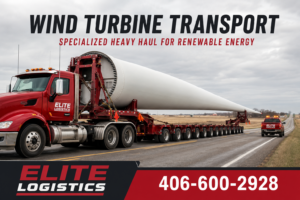
Elite Logistics provides specialized heavy-haul transportation for wind turbine blades and renewable-energy equipment.
Permits, Regulations, and Route Planning for Heavy Haul Loads
Every heavy haul move starts long before the truck leaves the yard. Oversize and overweight loads require state-specific permits, and routes have to be planned around bridge weight limits, overhead clearances, road construction, and local restrictions that can change week to week. Escort vehicles, pole cars, and law enforcement coordination are often required for the widest or heaviest loads, and permit timelines can stretch from a few days to several weeks depending on the states involved.
For shippers, this is where experience matters most. A heavy haul carrier that handles permitting and routing in-house — rather than treating it as an afterthought — is the difference between a move that stays on schedule and one that stalls out waiting on paperwork.
Choosing the Right Heavy Haul Trucking Partner
Not every flatbed carrier is equipped for heavy haul work. Shippers evaluating carriers for oversized freight should look for:
- A track record of legal, permit-compliant moves across multiple states
- In-house or closely managed routing and permit expertise
- Well-maintained specialized trailers rated for the load classes being hauled
- Responsive dispatch that can adjust to weather, road closures, or permit delays
- Transparent communication throughout the move, not just at pickup and delivery
For a deeper look at what separates strong carriers from the rest, see our flatbed trucking company selection guide — many of the same evaluation criteria apply directly to heavy haul.
How Elite Logistics Supports Heavy Haul and Specialized Freight
Elite Logistics, based in Manhattan, MT, and a Trinity Logistics partner, moves heavy haul, flatbed, hot shot, and specialized freight throughout the Northern Rockies and beyond. As demand for oversized and heavy equipment transport continues to climb in 2026, having a carrier that already understands permitting, routing, and multi-axle equipment requirements matters more than ever.
Learn more about our heavy haul trucking services or check current heavy haul rates and requirements for your next oversized move.
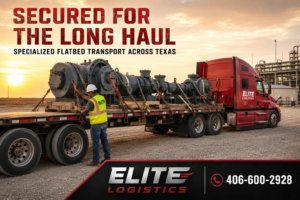
Elite Logistics carefully secures oversized steel machinery for specialized flatbed transportation across Texas.
Frequently Asked Questions
What does SPMT stand for?
SPMT stands for self-propelled modular transporter, a type of multi-axle hydraulic trailer that can drive and steer itself without a separate tractor.
How is an SPMT different from a standard heavy haul trailer?
A standard heavy haul trailer needs a tractor to pull it. An SPMT has its own hydraulic power pack and independently driven axle lines, letting it steer, rotate, and move sideways under its own power.
How much weight can an SPMT carry?
Capacity depends on the configuration, but modular platforms can be linked together to carry loads ranging from tens of tons up to thousands of tons for the largest industrial and shipyard moves.
What industries use SPMT and heavy haul transport most?
Renewable energy, data center construction, oil and gas, shipbuilding, and heavy industrial manufacturing are the biggest users of SPMT and multi-axle hydraulic modular trailer transport.
Why are heavy haul rates so high right now?
Growing freight dimensions from data center and renewable energy projects, combined with a shrinking pool of qualified specialized drivers, are pushing heavy haul and oversized load rates higher than most other freight categories.
Do heavy haul loads always require permits?
Yes. Oversize and overweight loads require state-specific permits, and routes must be planned around bridge limits, clearances, and local restrictions before the load ever leaves the yard.
How far in advance should I book a heavy haul move?
Because permitting and routing can take days to weeks depending on the states involved, it’s best to contact a heavy haul carrier as early as possible once load dimensions and pickup timing are known.
If you have an oversized or specialized load coming up routing, permitting, and equipment options.