

Trucking Industry News July 2026
Trucking Industry News July 2026: Rates, Regulations, and What’s Actually Changing
If you ship freight in or out of Montana, July delivered a lot to track. Spot rates climbed even as fuel prices dropped, the Federal Motor Carrier Safety Administration (FMCSA) rolled out a batch of new rules, and the freight market kept sending mixed signals about where the rest of 2026 is headed. Elite Logistics LLC breaks down the trucking industry news for July 2026 that actually matters for shippers — no jargon, no filler, just what’s moving freight rates and what you need to plan around.

Freight Rates and Capacity: A Market Running Hot
The single biggest theme in trucking industry news this July was capacity. According to the July 2026 State of the Industry Report, spot rates, rejection rates, and volumes all reached new annual highs, signaling strong seasonal demand and constrained capacity. That’s a notable shift from the soft-pricing environment carriers dealt with over the past several years.
Two forces are driving it. First, ongoing barriers to entry and limited fleet expansion are keeping capacity tight, which is the primary reason rates keep climbing even as broader economic indicators stay mixed. Second, tariff uncertainty is pulling forward ocean shipments, driving an early peak and increased freight volumes across modes — meaning importers rushed inventory in ahead of expected tariff changes, and that freight still has to move inland by truck and rail.
The spread between spot and contract pricing is where shippers are feeling it most. Spot rates are significantly outpacing contract rates, and the widening spread is creating upward pressure on contract pricing and increasing routing guide disruption — in plain terms, if your contracted carrier can’t cover a lane, the replacement cost on the spot market is climbing fast. For a deeper breakdown of how 2026 rates are actually built lane by lane, see our Freight Shipping Rates and Costs guide.
Diesel, meanwhile, moved the opposite direction. Diesel fuel prices fell another $0.164 from the prior week, settling at $4.668 per gallon nationwide, though prices are still $0.941 higher than a year ago. Falling fuel costs haven’t slowed rate growth — a sign that capacity, not fuel, is the dominant pricing factor right now.
Underneath the strong headline numbers, the freight economy is showing real strain at the small-carrier level. A mid-July report found nearly 250 job cuts at logistics facilities across four states and nine recent bankruptcy filings in trucking and supply chain services in a two-week span. Filings ranged from an FMCSA-registered motor carrier in Virginia running just two trucks to a California trucking firm liquidating assets after a multimillion-dollar legal claim. It’s a reminder that tightening capacity and rising rates are, in part, a byproduct of undercapitalized carriers exiting the market — which is exactly why vetting a freight partner’s financial stability and compliance record matters more in 2026 than in years past.
FMCSA Regulatory News: What Changed in July
July was an active month for FMCSA rulemaking, and several changes are worth flagging for anyone managing carrier compliance.
Three deregulatory rules took effect July 22. FMCSA finalized changes that remove the requirement that CDL holders self-report certain motor-vehicle convictions to their state licensing agency, rescind the requirement to keep a physical ELD operator’s manual in the vehicle, and revise roadside inspection procedures so a signed, corrected report is only required if the issuing state requests it. Carrier obligations aren’t going away, though — motor carriers must still run annual MVR checks, maintain driver qualification files, and ensure drivers stay qualified. McFarlane
Non-domiciled CDL enforcement is tightening. FMCSA has been pressing states on this issue all month, going so far as to warn Illinois to fix its non-domiciled CDL program or face decertification and the loss of up to $128.6 million in federal highway funds. This follows FMCSA’s broader move to finalize strict new non-domiciled CDL standards, initiating a five-year staggered phase-out affecting an estimated 200,000 drivers. If your carrier network includes non-domiciled CDL holders, this is a compliance area to watch closely through the rest of the year.
Autonomous trucking took another regulatory step forward. On July 10, FMCSA activated a waiver letting Aurora’s driverless trucks satisfy standard warning-device requirements by alternative means, since a warning device requirement written for a human driver assumes that driver can safely exit the vehicle and place a triangle behind it after a breakdown — something a driverless truck obviously can’t do. It’s a narrow, company-specific waiver, but it signals how federal rules are starting to bend around autonomous freight technology.
Older ELD models are being phased out. FMCSA continued revoking noncompliant electronic logging devices, bringing the total to 67 removed since January 2025, with carriers using Safe ELD or MYLOGS ELD given until July 7, 2026, to replace them or face out-of-service orders. If your fleet or your carriers are running either of those systems, confirm they’ve made the switch.
For the official rulemaking calendar and current compliance requirements, FMCSA’s own regulatory guidance is the best primary source: fmcsa.dot.gov.

FMCSA finalized several rule changes to CDL reporting and inspection procedures effective July 22, 2026
Infrastructure and Regional Notes
A few infrastructure items are worth flagging for anyone routing freight through the Midwest or border crossings. The Gordie Howe International Bridge between Detroit and Windsor, Ontario — a major freight corridor — is projected to allow up to 400 commercial vehicles per hour once fully operational, with an opening now targeted for late July after a weeks-long delay from its original schedule. Meanwhile, states including Illinois, Kentucky, Louisiana, Mississippi, and Wyoming are receiving funding to add new truck parking spaces and plan for future capacity needs — a small but meaningful development given how chronic the truck parking shortage has been nationally.
On the LTL side, two major LTL carriers issued Midwest service embargoes during the last week of June heading into July, and imports were tracking up roughly 15% — both signs of a freight network under real pressure heading into the back half of the year.
What This Means for Montana Shippers
Tight capacity and rising spot rates hit regional and rural shippers differently than they hit major metro lanes. When national capacity tightens, rural and specialized freight — produce, farm equipment, oversized loads — often feels it first, because fewer carriers are willing to chase those lanes when easier freight is paying well elsewhere.
That’s exactly why Elite Logistics LLC built a full-service fleet rather than specializing in a single freight type. Whether you need refrigerated trucking to move a harvest before it turns, flatbed capacity for equipment or construction materials, or heavy haul and specialized freight for oversized loads, having a Trinity Logistics partner with breadth across long-haul, produce, and specialized service lines means you’re not left scrambling when a single-lane carrier can’t cover your load. We covered the broader capacity squeeze in more detail in our 2026 Trucking Industry Crisis guide, which is still playing out in real time this July.
If you’re planning a farm equipment move ahead of harvest season, our Farm Equipment Shipping Cost Guide breaks down current pricing by equipment size and permit requirements — worth a look before capacity tightens further into fall.
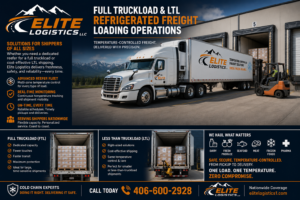
FTL & LTL Reefer Dock Operations
FAQ: Trucking Industry News July 2026
Why are trucking spot rates rising in July 2026 even though diesel prices are falling?
Capacity is the dominant factor, not fuel. Limited fleet expansion and barriers to entry are keeping available trucks tight even as demand rises, which pushes spot rates up regardless of what’s happening at the pump.
What FMCSA rules took effect on July 22, 2026?
Three deregulatory rules: the removal of CDL self-reporting for certain convictions, the elimination of the physical ELD manual requirement, and a change to when carriers must return corrected roadside inspection reports.
Do carriers still need to run background checks on drivers after the CDL self-reporting rule changed?
Yes. Carriers are still required to run annual motor vehicle record checks, maintain driver qualification files, and confirm drivers remain qualified — the rule change removes a driver’s self-reporting obligation, not the carrier’s compliance duty.
What’s happening with non-domiciled CDLs in 2026?
FMCSA finalized new standards with a five-year phased approach affecting an estimated 200,000 drivers, and the agency is actively pressuring states like Illinois to bring their non-domiciled CDL programs into compliance or risk losing federal highway funding.
Are Safe ELD and MYLOGS ELD devices still compliant?
No. FMCSA gave carriers using either device until July 7, 2026, to replace them, and both are part of a broader list of 67 ELD models the agency has revoked since January 2025.
How is the current freight market affecting rural and specialized freight in Montana?
Rural, agricultural, and specialized freight lanes tend to feel capacity crunches earlier than major metro corridors, since fewer carriers pursue those loads when easier freight elsewhere is paying well. Working with a full-service carrier that covers multiple freight types helps reduce that exposure.
Is autonomous trucking regulation actually moving forward in 2026?
It’s moving in narrow steps. FMCSA’s July waiver for Aurora’s driverless trucks addresses a single equipment requirement for one company, but it’s an early signal of how federal rules are beginning to adapt to autonomous freight operations.