
Our Blogs
Explore expert tips, industry updates, and practical advice to make smarter logistics decisions.
Freight Theft in 2026
Freight Theft in 2026: What Shippers Need to Know to Protect Every Load
A trailer sits overnight in a truck stop outside Memphis. By morning, it’s empty — no broken lock, no alarm, no witnesses. Or a legitimate-looking broker calls with a load tender, produces a real MC number, and vanishes with $180,000 of electronics before anyone realizes the paperwork was fake. Both are freight theft. Neither looks the way most shippers picture it.
Freight theft prevention starts with physical security and verified carriers.
Cargo theft has moved from a background risk to a front-page operational threat. Industry data from the American Transportation Research Institute puts the annual cost to the U.S. trucking industry at roughly $6.6 billion a year — more than $18 million a day in losses tied to stolen freight, according to reporting cited by Fortune. Verisk Cargo Net’s 2025 analysis found estimated losses surged 60% year-over-year to nearly $725 million, even as criminal networks became more selective, pushing the average value per stolen load up 36% to roughly $274,000. For any shipper, carrier, or broker moving freight across state lines, freight theft is no longer a rare bad day — it’s a cost of doing business that has to be actively managed.
This guide breaks down how freight theft actually happens in 2026, what’s being targeted, where the risk is concentrated, and the concrete steps Elite Logistics LLC takes to keep your cargo — and your bottom line — protected from pickup to delivery.
The Three Types of Freight Theft
Straight theft and strategic theft require different prevention strategies.
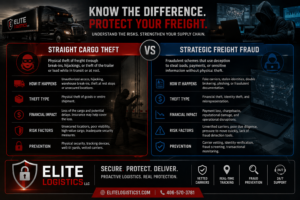
Not all cargo theft looks the same, and understanding the difference matters because the prevention strategy for each is different.
Straight theft is the most familiar version: cargo physically stolen from a truck stop, drop lot, distribution center, or rail yard, often while a trailer sits unattended overnight. This is the classic “broken lock, empty trailer” scenario, and it remains the most common form of cargo crime nationwide.
Strategic theft, sometimes called theft by deception, relies on fraud rather than force. Criminals impersonate legitimate carriers or brokers, use stolen motor carrier identities, and trick shippers into handing loads directly to thieves through fraudulent booking. This category has grown sharply in recent years as digital load boards and email-based booking have expanded the attack surface for identity theft in freight.
Pilferage is smaller-scale but persistent — partial theft from a load rather than the whole shipment, often occurring during transit stops or at overnight parking. It’s less dramatic than a full trailer disappearing, but it adds up fast across a large operation.
Freight Theft Statistics and Trends in 2026
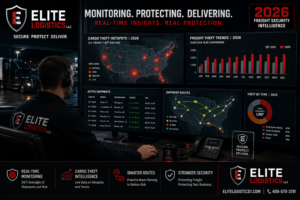
Real-time dispatch monitoring is central to identifying theft risk before it happens.
The freight theft landscape shifted noticeably heading into 2026, and the trend lines matter for how shippers should think about risk.
- Verisk Cargo Net recorded 767 supply chain crime events across the U.S. and Canada in Q1 2026 — a modest year-over-year decline in raw incident count, but estimated losses held steady at over $131 million, meaning criminals are targeting fewer, higher-value loads rather than opportunistic theft.
- Fraud-based and impersonation schemes are climbing fast. Overhaul’s Q1 2026 Cargo Theft Report found deceptive pickup schemes — where thieves pose as the legitimate carrier to collect freight directly from the shipper — jumped 31% even as overall incident volume dipped.
- Geography is shifting. California and Texas remain the top two states for reported cargo theft, but Illinois surged from 6% of national incidents in Q1 2025 to 13% in Q1 2026, with nearly half of those thefts targeting electronics. Tennessee, particularly the Memphis logistics corridor, has also emerged as a growing pilferage hotspot tied to overnight and early-morning unattended freight.
- Target categories are evolving. Food and beverage remains the single most targeted category by volume. Metal theft rose sharply — up 77% in 2025 — driven by copper demand, while enterprise computing hardware, cryptocurrency mining equipment, and high-value engine components have emerged as premium targets for organized groups.
- Criminal sophistication is increasing even as raw incident counts fluctuate. Verisk Cargo Net’s own analysis put it plainly: anti-fraud tools deployed across the industry are working, which is forcing criminal networks to invest in more elaborate identity theft and carrier-impersonation schemes rather than abandoning the effort altogether.
The takeaway for shippers: fewer trailers are getting broken into at random, but the criminals who are still operating are better organized, more selective, and increasingly focused on tricking their way into a legitimate-looking transaction rather than breaking a lock.
How Freight Theft Impacts Your Bottom Line
The stolen goods are only the starting point. A single theft event triggers a cascade of secondary costs that often exceed the value of the freight itself:
- Replacement shipment costs to re-source and re-ship the lost product on a compressed timeline
- Insurance premium increases following a claim, sometimes for multiple renewal cycles
- Investigation and claims administration expenses
- Contractual penalties for late or non-delivery to the end customer
- Reputational damage with shippers and receivers who lose confidence in the carrier relationship
This is exactly why cargo insurance coverage — and understanding what your policy actually covers before a load ever leaves the dock — is as important as the physical security measures on the truck itself. If you haven’t reviewed how liability, cargo, and contingent cargo insurance interact on a long-haul shipment, our guide to freight insurance for long-haul shipments breaks down who’s actually on the hook when something goes wrong — theft included.
Freight theft losses also feed back into the broader freight shipping rates and costs shippers see across the market, since insurance and security costs are baked into carrier pricing in high-risk lanes and commodity categories.
What Makes a Shipment a Target
Criminal networks aren’t stealing at random — they’re targeting freight that’s easy to move, hard to trace, and reliably in demand on secondary markets. Based on 2025–2026 industry reporting, the highest-risk categories include:
- Electronics, enterprise computing hardware, and cryptocurrency mining equipment
- Food and beverage, particularly meat, seafood, and tree nuts
- Pharmaceuticals and specialty medical freight
- Metal and copper-based products
- Auto parts, tires, and engine components bound for assembly plants
- High-value agricultural equipment during peak harvest and planting windows
Theft activity also peaks seasonally — July, November, and December see elevated incident rates as freight volumes spike around holidays and harvest season stretches trucking and warehouse capacity thin.
How to Prevent Freight Theft — Physical and Technology Layers
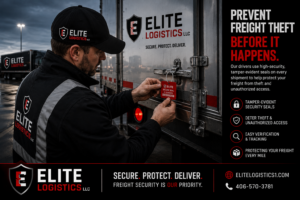
Tamper-evident seals confirm load integrity from pickup to final delivery.
Effective cargo theft prevention works in layers. No single measure stops a determined, organized theft ring, but stacking multiple deterrents dramatically reduces both the odds of a successful theft and the speed of recovery if one occurs.
Physical security layers:
- Kingpin locks secure the fifth-wheel connection to prevent a trailer from being hitched and driven away by an unauthorized tractor.
- Landing gear and air cuff locks immobilize a trailer by locking the landing gear or disabling the air brake system.
- High-security, tamper-evident seals confirm load integrity from origin to destination — a broken seal is an immediate red flag before the freight is even counted.
- Secured, well-lit parking at vetted facilities rather than open truck stops or unmonitored drop lots, especially for overnight stops.
Technology and process layers:
- Real-time GPS tracking with geofencing alerts dispatch the moment a trailer deviates from its planned route or stops outside an approved zone — turning a theft in progress into a theft that’s caught within minutes, not hours.
- Carrier identity verification at the tender stage — confirming MC number, insurance certificates, and driver credentials directly rather than trusting inbound contact information alone — is the single most effective defense against strategic theft and impersonation fraud.
- Load tender confirmation protocols that require a callback to a verified phone number before a driver is dispatched to a pickup, closing the door on spoofed emails and lookalike domains.
- Driver and dispatch training on recognizing pressure tactics, last-minute rate or route changes, and other red flags common in deceptive pickup schemes.
How Elite Logistics LLC Protects Your Freight
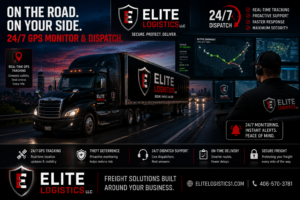
Every Elite Logistics LLC load moves under verified, FMCSA-compliant carrier protection.
Cargo security isn’t a bolt-on service at Elite Logistics LLC — it’s built into how every load moves, across every trailer type in our network.
Every carrier in our vetted network is fully insured and FMCSA-authorized, and we verify compliance for every driver and every load before dispatch — not after something goes wrong. Our 24/7 live dispatch team provides real-time GPS tracking and location visibility on every shipment, whether it’s flatbed freight carrying exposed, high-value structural steel, temperature-sensitive refrigerated freight, or a time-critical hot shot trucking load that can’t afford a delay caused by theft-related rerouting.
For specialized freight and heavy haul shipments — where a single load can represent hundreds of thousands of dollars in equipment — our permit specialists and dispatch team coordinate route planning that avoids known high-risk corridors and unsecured overnight parking wherever possible. And because intermodal freight shipping moves sealed containers intact between truck, rail, and ocean carriers with far fewer handling touchpoints than multi-stop LTL, it inherently reduces the number of opportunities for pilferage along the route.
Chain-of-custody documentation — bill of lading, load condition reports, GPS route history, and delivery confirmation — accompanies every shipment, giving your team the paper trail needed for insurance claims, audits, or law enforcement reports if an incident does occur. Explore our full lineup of freight transportation services to see how these protections apply across every trailer type we operate.
What to Do If Your Freight Is Stolen
If a theft does occur, speed matters. Recovery rates drop quickly once stolen freight enters resale channels, so the first hours are critical:
- Report immediately to local law enforcement and file a police report — this is required for most cargo insurance claims.
- Notify your carrier or broker and your insurance provider the same day, with all available shipment documentation.
- Preserve GPS and tracking data from the shipment before it’s overwritten or archived.
- Report the incident to Cargo Net (if your carrier participates) to flag the stolen goods across the industry’s shared theft database, which improves recovery odds and helps other shippers avoid the same fraud pattern.
- Document everything — bill of lading, seal numbers, driver information, and any communication with the booking party, especially for suspected strategic theft or impersonation fraud.
Frequently Asked Questions
What is the difference between cargo theft and freight theft? The terms are used interchangeably in the industry. Both refer to the unauthorized taking of goods while in transit or in transit-related storage, whether through physical theft, fraud, or pilferage.
How much does freight theft cost the trucking industry each year? Industry estimates from the American Transportation Research Institute place the total cost at approximately $6.6 billion annually, factoring in stolen goods, insurance costs, and secondary business disruption.
What is strategic cargo theft? Strategic theft uses fraud and deception — such as carrier impersonation, spoofed booking emails, or stolen motor carrier identities — to trick a shipper or broker into voluntarily releasing freight to criminals instead of the legitimate carrier.
Is stolen freight covered by insurance? Coverage depends on the specific cargo insurance policy in place and who holds it — the shipper, the broker, or the carrier. Reviewing policy terms before freight moves is the best way to avoid gaps in coverage. See our freight insurance guide for a full breakdown.
How does Elite Logistics LLC prevent freight theft? Through FMCSA-verified, fully insured carriers, real-time GPS tracking on every load, verified load tender protocols, secured parking coordination, and complete chain-of-custody documentation from pickup to delivery.
Closing CTA
Freight theft isn’t going away — but the loads that get targeted are rarely the ones moving under active GPS monitoring with a verified, FMCSA-compliant carrier and a dispatch team watching in real time. If cargo security is a priority for your next shipment, request a freight quote from Elite Logistics LLC and talk to our dispatch team about the specific protections in place for your load.