

What Water Cutbacks Mean for Shippers
What Water Cutbacks Mean for Shippers: Adapting Reefer Freight to a Changing Harvest Calendar
Water cutbacks reefer freight planning has quietly become one of the most important variables in Southwest agricultural logistics. For decades, shippers built their produce trucking schedules around weather, labor, and market demand. Now a fourth factor is reshaping the calendar just as forcefully: how much Colorado River water a farm actually gets to use.
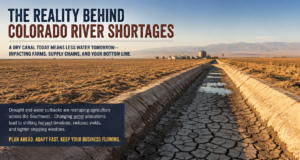
Colorado River Shortages and Southwest Agriculture — A dry irrigation canal illustrates how reduced water allocations can affect farms, harvest schedules, agricultural supply chains, and shipping windows throughout the Southwest.
The Colorado River basin is heading into one of the most consequential years in its history. Federal officials released a long-awaited framework in early August 2026 that would require Arizona, California, and Nevada to cut their combined water use by 3 million acre-feet over the coming decade — a reduction of 16 to 20% through 2028. Lake Mead and Lake Powell are near record lows, and the current operating guidelines that govern how the river is shared expire at the end of this year with no seven-state agreement yet in place. For shippers, brokers, and carriers who move produce out of the Southwest, this isn’t a distant policy story. It’s a direct input into next year’s freight volume, lane density, and harvest timing.
Why Water Cutbacks Are a Freight Problem, Not Just a Farming Problem
Reefer capacity has always followed the harvest. Produce season is a wave that starts in the desert Southwest in late winter, rolls through California’s Central and Imperial Valleys in spring and summer, and pushes north into the Pacific Northwest by late summer. Elite Logistics LLC’s produce trucking team plans capacity around that predictable rhythm every year.
Water cutbacks disrupt the predictability that makes this planning possible. When a grower doesn’t know how much acreage they’ll actually be able to irrigate, they can’t commit to a planting plan months in advance — and a shipper can’t commit to lane capacity around a harvest that might not happen the way it did last year.
Elite Logistics Produce Reefer Freight — Workers load fresh produce into an Elite Logistics refrigerated trailer, illustrating temperature-controlled transportation, cold chain reliability, and on-time produce shipping.
In Arizona’s Pinal County — one of the state’s most significant agricultural corridors — the pattern is already well established. Deeper cuts to Central Arizona Project supplies have pushed growers toward fallowing large shares of their land. Water cuts are expected to take out 30 to 40 percent of crop acreage in the Pinal County agricultural corridor, an area that has historically produced roughly half of Arizona’s agricultural sales. Individual farmers report even steeper impacts: one grower told a local water official he might have to cut active acreage by as much as half, while another expects to fallow a quarter to a third of a 2,000-acre operation.
That kind of acreage reduction doesn’t just shrink freight volume — it changes what gets planted in the first place. Growers facing water uncertainty are shifting toward lower-water, higher-value crops and away from water-intensive staples, which changes the mix of commodities moving through reefer lanes. A carrier that expects a steady volume of one crop type may instead see a smaller, more concentrated harvest window for a different one entirely.
How the Harvest Calendar Is Already Shifting
Refrigerated freight has always been seasonal, but the shape of that seasonality is becoming less reliable. Historically, the produce wave has moved predictably: Southeast harvests in winter and early spring, a transition to California’s San Joaquin and Imperial Valleys by late spring, Pacific Northwest cherries and stone fruit by early summer, and apples and potatoes in the Northwest by fall.
Water-driven acreage cuts in Arizona and California are compressing and destabilizing pieces of that wave. Fields that once anchored predictable spring volume in Pinal County or the Yuma growing region may sit fallow in a given year, while other operations shift crop mix or planting dates to work around reduced allocations. For a carrier managing capacity around the calendar, that means:
- Shorter, less predictable harvest windows in cutback-affected regions, increasing the value of flexible dispatch and short-notice capacity
- Volume shifting between growing regions as growers with junior water rights scale back and operations with better access pick up relative market share
- Greater year-to-year variability in which crops dominate a given lane, requiring carriers to stay current on grower conditions rather than relying on last year’s pattern
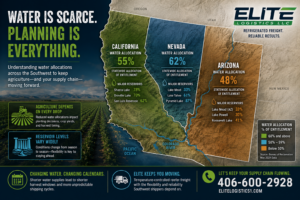
Southwest Water Allocation and Agricultural Shipping — A regional map highlights Arizona, California, and Nevada to illustrate how changing water supplies and reservoir conditions can influence farming, harvest calendars, and refrigerated freight planning.
Elite Logistics LLC’s refrigerated trucking network is built to absorb exactly this kind of variability — pre-cooling protocols, continuous temperature monitoring, and dispatch relationships across multiple growing regions mean capacity can reposition as harvest timing shifts, rather than being locked into a single region’s calendar.
What This Means for Shippers Planning Around the 2026–2027 Season
If you ship produce out of Arizona, California, or anywhere downstream of Colorado River allocations, a few practical adjustments are worth building into your planning now:
1. Confirm acreage and planting plans earlier than usual. Growers themselves may not have full clarity on water allocations until closer to planting season. Building in more frequent check-ins with grower-shippers helps you catch volume changes before they become a capacity emergency.
2. Diversify growing-region relationships. A shipper relying heavily on one water-constrained region carries more schedule risk than one with relationships spanning multiple states. Elite Logistics LLC’s outreach and dispatch relationships across Arizona, California, Utah, Idaho, and Washington growing regions are built specifically to give shippers this kind of flexibility.
3. Build flexibility into rate agreements. Seasonal rate escalators that account for compressed harvest windows or last-minute volume shifts protect both shippers and carriers from the kind of scramble that happens when a harvest window shrinks unexpectedly. Our freight shipping rates guide breaks down how these seasonal and lane-based adjustments are typically structured.
4. Treat short-notice capacity as a planning tool, not a backup plan. When harvest timing becomes less predictable, the ability to secure a truck on short notice — through hot shot trucking for smaller urgent loads or expedited reefer dispatch for full truckloads — becomes a core part of managing risk rather than an emergency fallback.
5. Watch the 2026 basin agreement closely. The current operating guidelines expire at the end of this year, and how the seven basin states resolve (or fail to resolve) a long-term plan will directly shape water availability — and therefore harvest volume — for years to come.

Elite Logistics Harvest & Reefer Freight Planning — A grower and logistics coordinator review harvest timing and refrigerated freight pickup schedules to help keep fresh produce moving efficiently from field to market.
The Bigger Picture: Why This Isn’t a Short-Term Story
It’s tempting to treat water cutbacks as a single bad season to plan around. The reality is longer-term. The Colorado River is on track for one of its driest years on record, and the combined storage in Lake Mead and Lake Powell has already reached historic lows. Even if the seven basin states reach a new operating agreement before the current guidelines expire, the underlying supply-demand imbalance in the river system isn’t going away. That means acreage decisions, crop mix, and harvest timing in Arizona and California are likely to remain more volatile than they were a decade ago — not less. r carriers and shippers, that argues for building water-awareness into long-term freight planning the same way fuel costs or labor availability already are: not as a one-time disruption to react to, but as a standing variable to plan around every season.

Elite Logistics Farm-to-Market Refrigerated Freight — An Elite Logistics reefer truck leaves a farm at sunrise, transporting temperature-sensitive produce with dependable cold chain service from field to market.
Elite Logistics LLC works directly with growers and shippers across the Southwest’s produce-growing regions to keep freight moving reliably, even as the conditions behind that freight keep changing. Whether you need standing seasonal capacity or short-notice dispatch when a harvest window shifts, our team plans around the realities on the ground — not just last year’s calendar. Request a freight quote to talk through your 2026–2027 growing-season shipping plan.
Frequently Asked Questions
1. Why are Colorado River water cutbacks affecting freight shipping?
Water cutbacks reduce the acreage farmers can irrigate, which changes how much produce is harvested, when it’s harvested, and which crops get planted. Since reefer freight demand follows the harvest, less predictable water allocations make harvest timing — and therefore freight volume — less predictable too.
2. Which states are most affected by the current water cuts?
Arizona, California, and Nevada face the deepest near-term reductions under the federal framework released in August 2026, with Arizona absorbing a disproportionate share due to its lower-priority water rights on the Colorado River.
3. How much farmland is being taken out of production because of water shortages?
In Arizona’s Pinal County alone, water cuts are expected to take 30 to 40% of crop acreage in the region’s agricultural corridor out of production, with some individual farms fallowing closer to half their land.
4. Does this mean produce shipping volume out of the Southwest will drop overall?
Not necessarily overall, but it will likely shift. Growers with better water access may take on more acreage as others fallow, and crop mix is shifting toward lower-water, higher-value crops. Volume is redistributing across regions and commodities rather than simply disappearing.
5. How can shippers protect themselves from harvest schedule uncertainty?
Diversifying grower relationships across multiple growing regions, building flexibility into rate agreements, and maintaining access to short-notice reefer and hot shot capacity all help shippers absorb schedule shifts without losing product or paying emergency rates.
6. When will there be more clarity on long-term Colorado River water allocations?
The current operating guidelines expire at the end of 2026. The seven basin states are working toward a longer-term agreement, but as of now no final deal has been reached, and the outcome will shape water availability — and farm planning — for years to come.
7. How does Elite Logistics LLC adjust to changing harvest windows?
Elite Logistics LLC’s dispatch team maintains relationships across multiple Southwest and Pacific Northwest growing regions, pairs standing reefer capacity with short-notice hot shot and expedited options, and coordinates directly with growers to plan around real-time harvest and water conditions rather than fixed seasonal assumptions.