

Heavy Haul Trucking in Texas
Heavy Haul Trucking in Texas: Permits, Routes & Rates for Oversized Freight
Heavy haul trucking Texas shippers depend on has to solve a different problem than almost anywhere else in the country: the state is big enough, industrial enough, and busy enough that oversized freight isn’t the exception — it’s routine. Between the Permian Basin, the Gulf Coast petrochemical corridor, and every major metro’s construction pipeline, a truck carrying something too heavy or too wide for a standard trailer crosses a Texas highway every few minutes of every working day.
🔵 Request a Heavy Haul Quote →
That volume doesn’t make the rules any looser. Texas still requires an oversize/overweight (OS/OW) permit the moment a load crosses the state’s legal thresholds, and getting a permit wrong — wrong route, wrong escort count, wrong axle math — is how a load ends up parked at a weigh station instead of on schedule. This guide covers what actually counts as heavy haul in Texas, where the freight moves, what permits and equipment it takes, and what shippers should expect to pay in 2026.

Elite Logistics provides heavy haul trucking and oversized load transportation for oil, gas, industrial, and energy equipment throughout West Texas and nationwide.
What Qualifies as Heavy Haul in Texas
A load doesn’t need to be enormous to trigger Texas’s oversize rules — it just needs to cross one threshold. Under TxDMV’s size and weight limits, any vehicle or load wider than 8 feet 6 inches, taller than 14 feet, or heavier than 80,000 pounds gross needs a permit before it can legally move on a Texas road — even if every other dimension is within limits.
“Heavy haul” specifically refers to the weight side of that equation: freight moving on specialized trailers like lowboys, RGNs (removable gooseneck), or step decks because it’s too heavy or too tall for a standard flatbed. Push much past 150,000 pounds and a shipment moves into superload territory — anything over 254,300 pounds gross, or certain axle-weight combinations — which requires engineering route review, bridge analysis, and multi-agency coordination before a wheel turns, per TxDMV’s superheavy permit rules.
Where Heavy Haul Freight Moves in Texas
Texas isn’t one heavy haul market — it’s several, layered on top of each other:
- The Permian Basin (West Texas, around Midland-Odessa) — drilling rigs, frac equipment, and production vessels. The basin was producing roughly 6.8 million barrels of oil per day as of mid-2026, according to the U.S. Energy Information Administration, and every rig move and tank battery installation out there needs a heavy haul carrier who knows the county road weight limits, not just the state ones.
- The Gulf Coast industrial corridor (Houston, Beaumont, Port Arthur) — refinery vessels, petrochemical reactors, and port-to-plant moves.
- DFW, Austin, and San Antonio — structural steel, cranes, and prefabricated components feeding the state’s ongoing construction boom.
- The Panhandle and West Texas wind corridor — turbine blades, nacelles, and substation transformers, some of the longest and most route-sensitive loads on Texas roads.
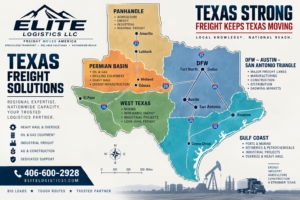
Elite Logistics provides Texas freight, heavy haul, oversized load, oilfield equipment, industrial freight, and specialized transportation across major Texas markets and freight corridors.
Elite Logistics LLC’s specialized freight services cover exactly this mix — oilfield equipment, wind components, and construction machinery — because the permitting and route-planning skill set is the same regardless of which industry the freight belongs to.
Texas Oversize Load Permits: What It Takes
Every state the load crosses needs its own permit, but Texas runs its system through TxPROS (Texas Permitting & Routing Optimization System). The main permit types shippers run into:
| Permit Type | Use Case | Typical Cost |
|---|---|---|
| General Single-Trip | One-time move, point A to B | $60 and up |
| 30/60/90-Day Width or Length | Recurring non-divisible loads | Varies by period |
| Annual Length Permit | Frequent shippers, same equipment | Up to $960 |
| Over Axle/Over Gross Weight Tolerance | Divisible commodities on select county roads | Requires $15,000 bond |
| Superheavy Single-Trip | Over 254,300 lbs, or axle-weight thresholds exceeded | Engineering review required |
A few Texas-specific wrinkles matter for heavy haul specifically: loads and vehicle combinations hauling equipment for natural gas or petroleum facilities are exempt from Texas’s legal length limits entirely, which matters a lot in the Permian and Eagle Ford. Travel windows are also tighter than shippers expect — most oversize moves are restricted to 30 minutes before sunrise through 30 minutes after sunset, with escort requirements scaling up once a load passes 12–14 feet wide.
Heavy Haul Trailer Types for Texas Freight
The right trailer depends entirely on weight and profile:
- Lowboy — 80,000+ lbs, low deck height for tall equipment like excavators and cranes
- RGN (Removable Gooseneck) — 150,000+ lbs, drive-on loading for heavy equipment
- Step Deck — up to 48,000 lbs, common for ag equipment and modular structures that don’t quite need a full lowboy
Elite Logistics LLC’s flatbed trucking page breaks down the full trailer-to-weight-limit table in more detail, including where each trailer type crosses into permit-required territory.
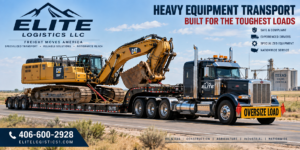
Elite Logistics provides heavy equipment transport in Texas using specialized lowboy trailers for excavators, construction machinery, oversized loads, and industrial equipment.
What Heavy Haul Trucking Costs in Texas
Rates for heavy haul and oversize freight in Texas run from a different baseline than standard flatbed. RGN and lowboy heavy haul trailers typically start around $3.40 per mile base, frequently with a $1,000+ minimum per load regardless of distance — a reflection of fixed permitting and route-planning costs that apply whether the haul is 50 miles or 500. On top of that base rate:
- State permits — $50 to $500+ per state, 1–5 business days processing
- Pilot car escorts — $400 to $800 per day per escort, with wider loads requiring both front and rear coverage
- Route surveys and engineering review — required for superload-class freight before the truck is even dispatched
For a full cost breakdown across hazmat, temperature-controlled, and oversize freight categories, Elite Logistics LLC’s specialized freight rates and requirements guide walks through the full pricing structure shippers should budget around in 2026.
Choosing a Heavy Haul Trucking Company in Texas
Not every carrier is set up to run oversize freight well. Look for:
- In-house permitting — a carrier who handles TxDMV/TxPROS applications directly moves faster than one who outsources it
- Route survey capability — bridge weight ratings, low clearances, and curfew windows should be checked before a truck loads, not discovered mid-route
- Industry-specific experience — oilfield, wind, and construction freight each have different securement and scheduling demands
- Pilot car coordination — a carrier who manages escorts directly avoids the delays of chasing down a separate vendor
With freight capacity tightening industry-wide — Elite Logistics LLC’s 2026 trucking industry crisis update covers how spot rates have moved this year — the carriers with permitting and route-planning already dialed in are the ones keeping oversize freight on schedule.
Elite Logistics LLC runs heavy haul trucking across Texas and nationwide, with in-house permit specialists managing TxDMV applications, route surveys, and escort coordination from quote to delivery.
Frequently Asked Questions
What size load requires an oversize permit in Texas?
Any load wider than 8’6″, taller than 14′, or heavier than 80,000 pounds gross requires a TxDMV oversize/overweight permit before moving on Texas roads.
How much does heavy haul trucking cost in Texas?
RGN and lowboy trailers typically start around $3.40 per mile base with a $1,000+ minimum per load, plus permit fees ($50–$500+ per state) and pilot car escorts ($400–$800/day) where required.
What is a superload in Texas?
A superload (Superheavy permit) applies to non-divisible freight exceeding 254,300 pounds gross weight, or certain axle-weight thresholds, and requires engineering review and route approval before movement.
Do oilfield and pipeline equipment loads get special treatment in Texas?
Yes. Truck-tractor combinations hauling machinery and materials for natural gas or petroleum facilities are exempt from Texas’s standard legal length limits, though weight and width rules still apply.
What trailer do I need for heavy equipment transport in Texas?
It depends on weight: step decks handle up to about 48,000 lbs, lowboys handle 80,000+ lbs, and RGN trailers are typically used for 150,000+ lb drive-on equipment.
Can oversize loads travel at night in Texas?
Generally no. Most oversize loads are restricted to daylight hours — 30 minutes before sunrise to 30 minutes after sunset — though some narrower loads have limited interstate night-travel allowances.
How long does it take to get a Texas oversize permit?
Standard single-trip permits are often processed within a few business days through TxPROS; superload and route-survey-dependent permits can take several weeks.