
Our Blogs
Explore expert tips, industry updates, and practical advice to make smarter logistics decisions.
Heavy Haul Shipping Rates & Requirements (2026)
Heavy Haul Shipping Rates & Requirements (2026): What You’ll Actually Pay
By Elite Logistics LLC | Published July 2026 | 10 min read
A wind farm contractor in eastern Montana needs a 42,000-lb transformer moved from a rail yard in Billings to a substation site three counties over. The quote that comes back isn’t a clean per-mile number — it’s a stack of line items: linehaul, a Montana oversize permit, a pilot car for the last 40 miles, and a note that the route survey found a bridge that needs a detour. That stack is heavy haul pricing in 2026, and it rarely looks like the simple “$X per mile” number that shows up in a Google search.
This guide breaks down what heavy haul shipping actually costs this year — by trailer type, by permit, and by escort requirement — so you know whether a quote is fair before you sign off on it.
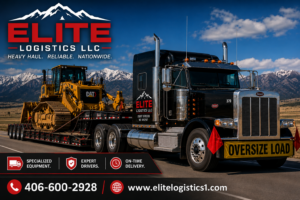
Elite Logistics LLC heavy haul flatbed truck transporting oversized construction equipment safely on a lowboy trailer along a mountain highway.
Heavy Haul Trucking Rates in 2026: The Baseline Numbers
Heavy haul doesn’t price like standard truckload freight, but it’s still useful to know where it starts. Across the broader market this year, standard flatbed is running roughly $2.50–$3.50 per mile, while specialized and heavy haul equipment — RGN, lowboy, multi-axle trailers — is commanding $3.40 to $4.00+ per mile before permits, escorts, or fuel surcharges are added. Loads requiring a removable gooseneck trailer on longer runs often average closer to $3.00 per mile on linehaul alone, with base minimums of roughly $1,000 per load regardless of distance.
Those numbers are a starting point, not a quote. Heavy haul pricing is load-specific in a way that dry van and even standard flatbed freight isn’t — there’s no clean market average to anchor a negotiation the way there is for a dry van lane. The real number comes from the load’s dimensions, weight, route, and the permits and escorts that route requires.
What Actually Drives Heavy Haul Pricing
Six variables build the final number on a heavy haul quote:
- Weight and dimensions. Anything over roughly 8.5 ft wide, 13.5–14.5 ft tall, or 80,000 lbs GVW crosses into oversize/overweight territory and triggers permit requirements. The further past those thresholds a load sits, the more it costs to move.
- Trailer type. Flatbed and step deck run cheaper than lowboy or RGN because they require less specialized equipment and driver training.
- Permits. Every state the load crosses requires its own permit, priced by that state’s own formula.
- Escorts (pilot cars). Required once a load crosses certain width, height, or length thresholds — and those thresholds are different in every state.
- Route complexity. Bridge weight ratings, low clearances, and road conditions can force a longer route than the straight-line distance, adding real miles and real cost.
- Season and capacity. Heavy haul capacity is structurally tighter than general freight — the pool of drivers with the right endorsements and equipment is a fraction of the standard truckload market — so rates firm up further during high-demand construction and harvest seasons.
For the equipment side of this equation specifically, see our Farm Equipment Shipping Cost Guide, which breaks down how these same weight and dimension thresholds apply to tractors, combines, and other ag machinery.
Trailer Types: Flatbed vs. Step Deck vs. Lowboy vs. RGN
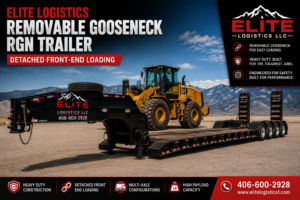
Elite Logistics LLC removable gooseneck (RGN) trailer demonstrating front-end loading of heavy equipment for oversized freight transportation and nationwide heavy haul services.
Choosing the right trailer isn’t just about what fits — it’s one of the biggest cost levers on a heavy haul quote:
- Flatbed: The baseline. Works for cargo that isn’t tall enough to need extra deck clearance. Least expensive of the heavy haul trailer types.
- Step deck (drop deck): A lower rear deck gives roughly 10’2″ of legal cargo height versus 8’6″ on standard flatbed — useful for tall equipment without paying for a lowboy.
- Lowboy: Drops the deck to 18–24 inches off the ground, giving 11’6″–12′ of height clearance. Built for very heavy, very tall equipment like excavators and bulldozers.
- RGN (removable gooseneck): Same low deck as a lowboy, but the front detaches so self-propelled equipment can drive on directly — no crane needed at pickup. This convenience carries a premium, typically the highest per-mile rate of the group.
A load’s overhang matters as much as trailer width. Tracked equipment with tracks extended can push a technically-legal-width trailer into oversize permit territory — which is exactly the kind of detail that changes a quote after the fact if it isn’t caught up front. This is one of the reasons Elite Logistics LLC measures dimensions and overhang before quoting, not after.
See our Flatbed Trucking Companies page for more on trailer specs, or our Specialized Freight Services page for how Elite Logistics LLC’s RGN and lowboy fleet handles oversized industrial and agricultural loads.
Permit Costs: Why They’re Never the Same Twice
Oversize and overweight permits are issued state by state, and every state uses its own formula. Some charge a flat fee; others charge a base fee plus a per-mile rate; several add surcharges once a load exceeds specific width, height, or weight thresholds. A few real examples from 2026 permit schedules:
- Texas: a base fee plus a per-mile charge, with an added surcharge per foot over 14 feet in width.
- Florida: seven-day oversize tiers running roughly $5–$25 depending on dimensions, with overweight runs priced per mile in weight brackets.
- New Mexico: a flat single-trip fee for oversize/overweight, with a ton-mile surcharge once weight passes 86,400 lbs.
On a multi-state move, those fees stack — and permit processing alone can take anywhere from same-day to 5–15 business days depending on the states involved and whether the load qualifies as a super load. That processing time needs to be built into the delivery window during quoting, not discovered after the truck is ready to roll.
Escort (Pilot Car) Requirements and Costs

Elite Logistics LLC pilot car escort safely leading an oversized load truck during heavy haul transportation with route planning, safety compliance, and nationwide escort services.
Most states require at least one escort vehicle once a load passes roughly 12 feet wide or 14 feet tall — though the exact trigger varies by state, road type, and even lane count. Loads over 16 feet wide are generally classified as super loads and can require multiple escorts, law enforcement involvement, or even temporary road closures.
Budget roughly $3–$5 per mile per escort vehicle on the legs of the route where one is required — and note that this is a separate line item from the linehaul rate, not something bundled into it. Height-restricted loads may also require a lead escort with a height pole, and some states mandate utility company notice a day in advance when a load approaches maximum bridge or wire clearances.
What a Real Heavy Haul Quote Includes
A complete, honest heavy haul quote accounts for all of the following — not just a mileage rate:
- Linehaul rate based on trailer type and distance
- Permit fees for every state on the route
- Escort vehicle costs on any leg where one is required
- Route survey costs for bridge and clearance verification on complex loads
- Fuel surcharge
- Deadhead miles if the equipment has to reposition empty afterward
- Loading/unloading equipment (crane or forklift) if the cargo isn’t self-propelled or drive-on capable
For a breakdown of how these same line items apply across freight types generally, see Freight Shipping Rates & Costs. And if a quote you’ve received only shows a single number with no breakdown, that’s worth a second look — it usually means one or more of these costs will show up later as a change order.
Why Heavy Haul Capacity Is Tighter Than Ever in 2026
Heavy haul and flatbed drivers require additional endorsements and equipment certifications, which means the qualified carrier pool is meaningfully smaller than the general truckload market — and that gap is widening as the broader driver shortage compounds. That structural tightness means heavy haul rates hold up even when general freight softens seasonally. For more on how this year’s capacity crunch is affecting pricing and lead times across every freight type, see our post on The 2026 Trucking Industry Crisis.
Elite Logistics LLC freight truck traveling through rural Montana, providing dependable nationwide freight transportation and logistics services.
How to Avoid Overpaying on a Heavy Haul Shipment
- Get exact dimensions before requesting quotes — including overhang on tracked or wide equipment, not just the trailer’s rated width.
- Ask for a line-item quote, not a single all-in number, so you can see exactly what’s built in and what isn’t.
- Confirm whether the load is truly non-divisible — permits only apply to cargo that can’t be broken down without damage, and this classification affects both cost and routing options.
- Apply for permits early if the route includes a state known for slower processing or engineering review on super loads.
- Compare full routes, not just distance — a slightly longer route through lower-fee states can beat a shorter route with expensive permits and multiple escorts.
Heavy Haul Rates & Requirements: FAQ
How much does heavy haul shipping cost per mile in 2026?
Flatbed and step deck heavy haul runs roughly $2.00–$3.50 per mile, while RGN and lowboy trailers typically run $3.00–$4.00+ per mile on longer hauls. Permits, escorts, and fuel surcharges are added on top of the linehaul rate.
What size load requires an oversize permit?
Most states require a permit once a load exceeds roughly 8.5 feet in width, 13.5–14.5 feet in height, or 80,000 lbs gross vehicle weight. Exact thresholds vary by state.
When is an escort vehicle required for a heavy haul load?
Many states require at least one escort once a load exceeds approximately 12 feet wide or 14 feet tall, though thresholds vary by state, road type, and lane count. Loads over 16 feet wide are typically classified as super loads and may require multiple escorts or law enforcement.
What’s the difference between a lowboy and an RGN trailer?
Both trailers drop the deck to 18–24 inches for extra height clearance. The difference is loading: an RGN’s front section detaches so self-propelled equipment can drive on directly, while a lowboy typically requires a crane or ramps. RGN service usually carries a higher per-mile rate.
Do permit fees cover escort vehicles?
No. Permit fees only cover the state’s authorization to move the load on public roads. Escort vehicles, route surveys, and law enforcement escorts are separate costs, priced independently.
Move Your Next Heavy Haul Load with Elite Logistics LLC
Elite Logistics LLC maintains a full heavy haul fleet — extendable flatbeds, multi-axle lowboys, and RGN trailers rated for loads exceeding 200,000 lbs — along with in-house permit management and pilot car coordination across all 48 contiguous states. Every quote is built line by line, so you know exactly what you’re paying for before the truck ever leaves the yard.
Visit our Heavy Haul Trucking page or request a quote today. You can also explore our full range of freight services, including hot shot trucking and produce trucking, or call us directly at (406) 600-2928.
Related reading: How to Prepare a Combine Harvester for Transport | How Much Does It Cost to Ship a Tractor? | Hot Shot Trucking Rates: What You’ll Actually Pay in 2026