
Our Blogs
Explore expert tips, industry updates, and practical advice to make smarter logistics decisions.
Hot Shot Trucking Rates: What You’ll Actually Pay in 2026
Hot Shot Trucking Rates: What You’ll Actually Pay in 2026
Hot shot rates get thrown around online as a single number — “$2 a mile” — but that number is almost never what shows up on your invoice. Here’s how hot shot pricing actually breaks down, what drives it up or down, and what a fair quote looks like for your load.
What you’ll actually pay for hot shot freight in 2026 — real costs, price factors, and a full rate breakdown.

Why “Average Hot Shot Rate” Is the Wrong Question
Search “hot shot trucking rates” and you’ll find a wide range of numbers — most of them pulled from owner-operator pay data, not shipper-paid pricing. Those are two different things. The per-mile figure a hot shot driver earns on a load board is the carrier’s cut. What you pay as a shipper includes that carrier line haul, plus fuel surcharge, plus — if you’re working through a broker — the margin that pays for dispatch, carrier vetting, insurance verification, and tracking.
That’s not a markup to be suspicious of. It’s the difference between calling a load board yourself and hoping a stranger shows up, versus having a dispatch team that vets the carrier, confirms equipment fit, and stays on the load until it’s delivered.
2026 Hot Shot Rate Ranges by Load Type
Real-world hot shot pricing in 2026 falls into a few predictable bands:
- Short regional runs (under 200 miles): Often quoted flat rather than per mile — typically $400–$900 total, since a minimum trip charge covers the carrier’s time regardless of distance.
- Standard mid-distance loads (200–500 miles): $1.50–$2.50 per mile on a flexible-deadline shipment.
- Long-haul hot shot (500+ miles): $1.25–$2.00 per mile, totaling roughly $1,500–$2,500+ depending on equipment and weight.
- Oilfield and remote-site delivery: $1.50–$4.00 per mile. Fewer carriers are willing to run to drill sites and rural job sites, and that scarcity shows up directly in the rate.
- Same-day / emergency dispatch: A 20–40% premium over the standard-deadline quote for the same lane, since the carrier is reshuffling their schedule — and often running empty miles — to reach you fast.
What Actually Moves a Hot Shot Rate

Elite Trucking LLC provides professional hot shot trucking and equipment hauling services with reliable pickup, on-time delivery, and nationwide transportation solutions.
Six factors do almost all the work in setting your price:
- Urgency — A flexible 3-day window prices far below “I need this moving in the next two hours.”
- Lane and location — Loads headed to oilfields, rural construction sites, or mountain terrain pay more because fewer carriers want the deadhead.
- Load weight and dimensions — Most hot shot freight runs 1,000–16,500 lbs on a gooseneck or flatbed trailer; anything pushing toward the top of that range, or requiring permits, costs more.
- Equipment type required — A standard flatbed gooseneck prices lower than a load needing a lowboy or specialized tie-down configuration.
- Deadhead miles — If the nearest qualified carrier is 150 miles from your pickup point, those empty miles get priced into your rate.
- Fuel surcharge — Adjusted against the current diesel index, the same way it works on long haul freight.
What a Realistic Hot Shot Quote Looks Like
Load: Bozeman, MT → Williston, ND oilfield site, 420 miles, gooseneck flatbed, 8,000 lbs, 2-day window
- Line haul: $1.85/mile × 420 = $777
- Fuel surcharge: $0.45/mile × 420 = $189
- Remote-site delivery premium: $150
- Total: approximately $1,116 (before any accessorials)
Compress that same load to a 4-hour emergency window, and expect the total to climb 20–40% as the carrier reprioritizes and likely repositions empty miles to reach you.
Hot Shot vs. LTL vs. FTL: Which Actually Costs Less?

Elite Trucking LLC provides dependable hot shot trucking and farm equipment transportation services, specializing in the safe and timely delivery of tractors, agricultural machinery, and oversized freight throughout the United States.
Hot shot is almost never the cheapest option on a strict per-mile basis — and it isn’t trying to be. LTL pricing is lower per pound when your freight is palletized and flexible on timing, since it shares trailer space with other shippers. FTL can cost less per pound on large shipments since you’re paying for one truck regardless of how full it is.
Hot shot wins when the cost of waiting exceeds the cost of the premium. A drilling rig down for six hours waiting on a part is a far bigger expense than the $300–$500 difference between hot shot and a slower alternative. Same logic applies to a stalled construction job site or a production line waiting on one missing component.
How to Get a Fair Hot Shot Rate
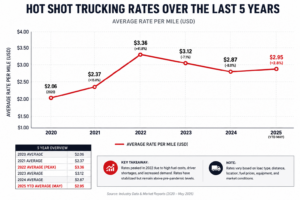
Average hot shot trucking rates per mile over the last five years, highlighting the freight market surge of 2022 and the subsequent stabilization of pricing through 2025.
- Give complete load details upfront — exact weight, dimensions, and pickup/delivery addresses get you an accurate quote on the first call, not a revised one after the truck shows up.
- Build in whatever deadline flexibility you actually have — even a few extra hours of pickup window can move you out of the emergency-premium tier.
- Ask whether the quote is flat or per-mile — and confirm fuel surcharge is itemized separately so you can compare quotes apples-to-apples.
- Work with a dispatcher who knows your lane — a broker with existing carrier relationships in your region avoids the deadhead premium that comes with cold-calling a load board.
FAQ
What are hot shot trucking rates per mile in 2026?
Standard loads typically run $1.25–$2.50 per mile, with urgent, remote, or oversized freight reaching $3.00–$4.00+ per mile. Short regional trips under 200 miles are often quoted as a flat $400–$900 rather than per mile.
How much does it cost to hire a hot shot trucking company?
Most shipments fall between $400 for a short regional run and $2,500+ for a long-haul load past 500 miles, before urgency premiums or specialized equipment charges.
Why do hot shot rates vary so much?
Urgency, lane location, and equipment move independently of each other. A same-day load to a remote site can cost two to three times more than a flexible-deadline load at the same mileage.
Is hot shot trucking cheaper than LTL or FTL?
Not usually per mile. It costs more than LTL or FTL on paper but wins on total cost when downtime, deadlines, or damage risk outweigh the price difference.
How is a hot shot trucking quote calculated?
Base rate (per mile or flat) plus fuel surcharge plus any urgency, equipment, or remote-location premiums — plus deadhead miles the carrier has to run to reach pickup.
Do emergency or same-day hot shot loads cost more?
Yes, typically 20–40% above the standard-deadline quote for the same lane.