
Our Blogs
Explore expert tips, industry updates, and practical advice to make smarter logistics decisions.
Farm Equipment Shipping Cost Guide (2026): What You’ll Actually Pay
Farm Equipment Shipping Cost Guide (2026): What You’ll Actually Pay
By Elite Logistics LLC | Published June 17, 2026 | 10 min read
A farmer in the Gallatin Valley needs a combine moved from an Iowa auction before the first week of harvest. A dealer three states away is quoting a customer on tractor delivery and has no idea whether to bid $800 or $3,000. An estate sale coordinator is staring at six pieces of equipment and one shipping deadline. In every one of these situations, the question is the same: what does farm equipment shipping actually cost in 2026, and why do quotes swing so wildly for what looks like the same job?
Elite Logistics LLC transports oversized farm machinery and agricultural equipment nationwide. This featured image highlights a flatbed semi hauling a tractor and planter while promoting the company’s 2026 Farm Equipment Shipping Cost Guide.
The honest answer is that farm equipment shipping cost is not one number — it is a calculation built from five variables that move independently of each other: distance, equipment size and weight, trailer type, permit requirements, and the calendar. Get a feel for how those five variables interact, and a $3,000 quote and an $800 quote on two different loads suddenly make complete sense instead of feeling like a guessing game.

Get a fast freight quote from Elite Logistics LLC — flatbed, heavy haul, hot shot, and specialized trucking across the U.S.
This guide breaks down real 2026 pricing ranges for tractor shipping, combine transport, and implement hauling, and explains exactly which factors are driving your number up or down.
Farm Equipment Shipping Cost Per Mile: The 2026 Baseline
Across the agricultural hauling industry, farm equipment shipping rates generally fall between $1.75 and $5.00 per mile, with most standard tractor and implement loads landing in the $2.00-$4.00 per mile range. Where a specific shipment falls in that band depends almost entirely on distance and equipment classification:
- Short hauls (under 200 miles): $4.00-$5.00+ per mile. Fixed costs like dispatch, loading time, and driver positioning are spread across fewer miles, pushing the per-mile rate up even though the total dollar amount is lower.
- Mid-range hauls (200-700 miles): $2.50-$3.75 per mile. This is the sweet spot where most standard tractor and single-implement shipments fall.
- Long-haul and cross-country moves (700+ miles): $1.75-$2.50 per mile. Per-mile cost drops as distance increases, but total shipment cost still climbs — a 1,200-mile combine move will cost more overall than a 300-mile tractor move, even at a lower per-mile rate.
Translated into real numbers, here’s what shippers are typically paying right now:
| Equipment & Distance | Typical Trailer | 2026 Cost Range |
|---|---|---|
| Compact tractor, 100 miles | Flatbed | $400 – $650 |
| Mid-size tractor, 500 miles | Flatbed / Step-Deck | $1,200 – $1,900 |
| Large 4WD tractor, 1,200 miles | Step-Deck / RGN | $2,500 – $4,500 |
| Combine harvester, 500 miles | RGN / Multi-Axle Lowboy | $2,200 – $3,800 |
| Combine harvester, 1,000+ miles (oversize permits) | RGN / Multi-Axle Lowboy | $4,000 – $7,500 |
| Skid steer / small implement, 300 miles | Flatbed | $650 – $1,100 |
Ranges reflect typical market pricing and will vary by route, carrier availability, and current fuel surcharges. Request a quote for an exact number on your specific load.
The Five Factors That Actually Move Your Price
1. Equipment Size and Weight
This is the single biggest driver of cost. A compact utility tractor under 10 feet tall ships on a standard flatbed at standard rates. A current-generation combine — something in the Case IH Axial-Flow or John Deere X-Series class — can weigh over 35,000 lbs and stand 13-14 feet tall even with the header detached, which immediately changes both the trailer requirement and the permit picture. Heavier, taller, wider equipment requires more specialized trailers, more careful route planning, and in many cases, formal oversize permitting — all of which add cost.
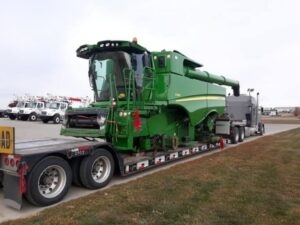
A combine harvester ready for oversize transport — secured, flagged, and marked with wide load signage for interstate hauling.
2. Trailer Type
Not every piece of equipment can ride on the same trailer, and trailer type has a direct relationship to price:
- Standard flatbed: The most cost-effective option, used for tractors under legal height, skid steers, and most smaller implements. See our full breakdown of flatbed equipment and trailer types for how flatbed compares to other configurations.
- Step-deck (drop-deck): Adds vertical clearance for taller tractors and telehandlers without triggering a height permit — a moderate cost increase over flatbed.
- Removable gooseneck (RGN): Required for self-propelled combines and machines that can’t be driven up a ramp. RGN trailers are less common in carrier fleets, which pushes rates higher.
- Multi-axle lowboy: Used for the heaviest loads — fully assembled planters, large grain carts, header trailers. The highest-cost trailer category, but also the only safe option for true heavy-haul agricultural freight.
3. Oversize and Overweight Permits
A standard legal load in the U.S. tops out at 8 feet 6 inches wide, 13 feet 6 inches tall, and 80,000 lbs gross vehicle weight. A surprising amount of agricultural machinery — combines, large planters, wide-swath sprayers — exceeds at least one of those thresholds. When that happens, every state crossed on the route requires its own oversize permit, and the load may also require pilot car escorts.
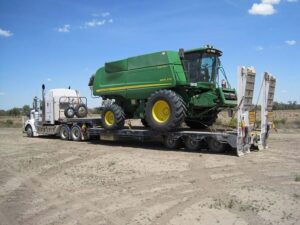
Self-propelled combines like this John Deere 9870 STS are driven directly onto a lowered RGN trailer, then secured for the haul.
Permit and escort costs vary by state and by how many state lines the route crosses, but shippers should expect this line item to add anywhere from a few hundred dollars to well over a thousand on a multi-state oversize combine move. This is also the area where working with an experienced heavy haul carrier pays for itself — permit lead times and routing mistakes are the most common source of delivery delays on oversize agricultural freight.
4. Seasonality
Farm equipment shipping rates are not flat year-round. Demand spikes hard during planting season (March-May) and harvest season (September-October), when farmers, dealers, and custom harvest operations are all trying to move equipment on the same compressed timeline. Carrier capacity tightens, and rates during these windows typically run 15-25% higher than the rest of the year. Winter months (December-February) are consistently the most affordable time to ship, when capacity is loosest and rates soften accordingly.
If your shipment timeline has any flexibility at all, booking outside peak planting and harvest windows is the single most effective lever for lowering total cost.
5. Route and Accessibility
Mileage is the obvious input, but route difficulty matters almost as much. A rural pickup down unpaved farm roads, a delivery into a congested metro area, mountain-pass routing, or tight bridge clearances on a low-clearance route all add time and complexity that carriers price into the quote. This is one area where a regionally based carrier has a real advantage — a broker with no on-the-ground knowledge of regional trucking conditions in places like Montana’s Big Sky Country or the broader Western freight corridors is quoting blind on terrain and access that a local partner already understands.
Flatbed vs. Step-Deck vs. RGN: Which Trailer Does Your Equipment Need?
Choosing the right trailer is a safety and legal requirement, not just a cost decision — but it also happens to be where most of the price variation in farm equipment shipping originates. Here’s the quick decision framework:
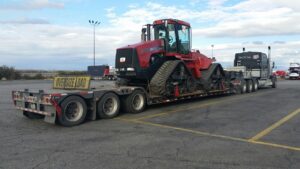
Track tractors like this Case IH STX450 often require oversize load signage due to their width and tread configuration.
- Choose flatbed if your equipment is under 8.5 feet tall and within standard width — most compact and mid-size tractors, mowers, rakes, and smaller implements.
- Choose step-deck if your equipment’s height would exceed flatbed clearance — common with large 4WD articulated tractors and telehandlers.
- Choose RGN if your equipment is self-propelled and can’t be driven up a ramp — virtually all combine harvesters fall into this category.
- Choose multi-axle lowboy for the heaviest assembled implements, where weight distribution across more axle points is required for road safety and compliance.
For a full side-by-side comparison of equipment categories, see our guide to dry van vs. reefer vs. flatbed trailer selection.
How to Lower Your Farm Equipment Shipping Cost
A few practical levers consistently reduce total cost without compromising safety or timeline:
- Book outside peak season. Shifting a non-urgent move out of the March-May or September-October windows can mean a 15-25% rate difference.
- Stay flexible on pickup and delivery dates. A tight delivery window forces a carrier to dedicate a truck specifically to your load. A flexible window lets the carrier work your shipment into an existing route.
- Consolidate multiple units. If you’re moving a tractor and a set of implements, ask whether they can ride on a single trailer or as a coordinated multi-unit move — see our long haul trucking rates breakdown for how consolidated loads affect per-unit pricing.
- Remove detachable attachments. Headers, raised platforms, and removable components that push a load into oversize territory can sometimes be detached and shipped separately at lower combined cost.
- Get multiple quotes from licensed, insured carriers. A quote that comes in dramatically below market usually signals an unverified or underinsured operator — a costly risk on equipment this valuable. Confirm FMCSA compliance before booking with any carrier or broker.
Why Equipment Owners Choose Elite Logistics LLC for Farm Equipment Shipping
Elite Logistics LLC is headquartered in Manhattan, Montana, and works in conjunction with Trinity Logistics — a Burris Logistics Company and top-20 U.S. freight brokerage — giving every farm equipment shipment access to a vetted network of 70,000+ authorized carriers, not a single regional fleet. That combination means the permit expertise, trailer selection, and route planning described in this guide aren’t theoretical — they’re handled in-house on every load we move.
Whether you’re shipping a single tractor or coordinating combine harvester transport across multiple states ahead of a harvest deadline, our team quotes transparently, with no hidden fees, and builds permit lead times into your timeline upfront instead of discovering them mid-shipment.
Get a transparent farm equipment shipping quote today. Call (406) 600-2928 or request a quote online.
Frequently Asked Questions
How much does it cost to ship a tractor?
Most tractor shipments cost between $1.75 and $5.00 per mile, with short hauls under 500 miles running higher per mile than cross-country moves. A compact tractor moved 100 miles might total around $400-$600, while a large 4WD tractor moved 1,200 miles can run $2,500-$4,500 depending on trailer type and permit needs.
Why does shipping farm equipment cost more during harvest season?
Demand for flatbed, step-deck, and RGN trailers spikes during planting and harvest windows because farmers, dealers, and custom harvest crews are all moving equipment at the same time. Carrier capacity tightens, and rates typically rise 15-25% above off-season pricing during these peak periods.
Do I need a permit to ship a combine harvester?
In most cases, yes. A standard legal load is capped at 8 feet 6 inches wide, 13 feet 6 inches tall, and 80,000 lbs gross weight. Combines frequently exceed the height and width thresholds even with headers removed, which triggers oversize permit requirements in every state the load crosses.
What’s the cheapest way to ship farm equipment?
Booking outside of planting and harvest season, allowing flexible pickup and delivery windows, consolidating multiple pieces of equipment onto one trailer, and removing detachable attachments to avoid oversize classification are the most reliable ways to lower farm equipment shipping costs.
How long does it take to ship a tractor or combine?
Standard shipments under 500 miles typically arrive in 2-3 days after pickup. Cross-country moves take closer to a week, and oversize loads requiring multi-state permits and pilot car escorts can add additional lead time for route approval before the truck even departs.