

Long Haul Trucking Rates Explained
Long Haul Trucking Rates Explained — Per Mile, Per Load, FSC
Long haul trucking rates look like a black box from the outside —
but every rate is built from the same handful of inputs. Once you know the inputs, you can predict the rate, push back when it’s off, and budget your freight spend without guessing.

Get a fast freight quote from Elite Logistics LLC — flatbed, heavy haul, hot shot, and specialized trucking across the U.S./
Per Mile vs. Per Load Pricing
Per mile — Most common for OTR. Rate × total miles = line haul. Useful for variable-length lanes or one-off shipments. A typical 2026 dry van OTR rate runs $2.20–$3.00 per mile depending on lane and market conditions.
Per load (flat rate) — Common for high-volume recurring lanes. The carrier quotes a flat number for the entire move (e.g., $3,800 LA to Dallas). Easier to budget, but less flexible if mileage changes.
Most carriers can quote either way — ask which is better for your freight profile.
What Drives the Per-Mile Rate – Six factors move the needle:
- Lane density — Common lanes (LA–Phoenix, Chicago–Atlanta) price lower because carriers always have trucks there
- Backhaul availability — Lanes where the carrier can find a return load price lower
- Equipment type — Dry van < reefer < flatbed < specialized
- Seasonality — Produce season (May–July), retail peak (Q4), and holidays move rates up
- Market conditions — National load-to-truck ratios shift rates monthly
- Fuel prices — Reflected through FSC, but high diesel still pressures base rates
How Fuel Surcharge Actually Works
The fuel surcharge (FSC) is a separate line item that adjusts weekly based on the DOE national diesel index. Standard formula:
(Current diesel price − base price) ÷ truck MPG = FSC per mile
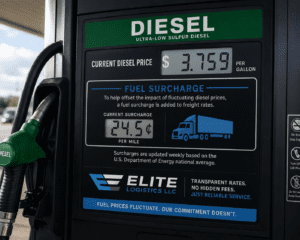
Example: If diesel is $4.20/gallon, base price is $1.20, and average truck MPG is 6: ($4.20 − $1.20) ÷ 6 = $0.50/mile FSC
The carrier publishes their FSC schedule weekly, and it should appear as a separate line on every quote and invoice. This is why two carriers quoting “the same” base rate can have wildly different totals — different FSC calculations.
What a Realistic Quote Looks Like
Load: Atlanta → Denver, 1,400 miles, dry van, standard freight
- Line haul: $2.40/mile × 1,400 = $3,360
- FSC: $0.50/mile × 1,400 = $700
- Total: $4,060 (plus any accessorials)
This is your baseline. If a quote comes in at $2,800 all-in, something is off — likely double-brokering or quote bait. If it comes in at $5,500, push back unless there’s a clear reason (specialized equipment, tight transit, peak season).
Spot Rates vs. Contract Rates
Spot rates — One-off pricing for one-off freight. Reacts to market conditions in real time. Higher highs, lower lows.
Contract rates — Negotiated annually for recurring lanes. More stable, usually 5–15% below spot in normal markets, but less flexible when markets drop.
Most shippers run a mix: contracts for predictable lanes, spot for surge and unique freight.
How to Lower Your Long Haul Rates Legitimately
- Commit to recurring volume on specific lanes
- Offer flexible pickup/delivery windows
- Avoid weekend pickups when possible
- Load and unload efficiently (no detention)
- Pay invoices on time (yes, this affects rates over time)
- Build relationships with 2–3 core carriers vs. shopping every load
FAQ
What’s a fair long haul trucking rate per mile in 2026? Dry van OTR generally ranges $2.20–$3.00/mile depending on lane and season. Reefer adds $0.30–$0.60/mile. Flatbed varies more by load specs.
Why do rates change week to week? Fuel surcharge updates weekly. Spot rates move with capacity and demand. Contract rates are usually annual.
Can I lock in a rate for a year? Yes — through a contracted lane agreement, though most include fuel surcharge adjustments and force majeure clauses.
CTA
Want straight rate quotes on your lanes? Talk to our long haul trucking team → and we’ll show you exactly how your rate is built.