

Navigating Multi-State Oversize Permits
Navigating Multi-State Oversize Permits: What Machinery Haulers Need to Know
If you’ve ever tried to move a combine, a dozer, or a piece of industrial equipment across three state lines, you already know the real challenge isn’t the driving — it’s the paperwork. Multi-state oversize permits are the single biggest source of delay, fines, and blown delivery windows for machinery haulers, because every state sets its own dimension thresholds, fees, travel curfews, and escort rules. There’s no unified national oversize permit. Each state DOT runs its own system, and a load that’s perfectly legal in Montana can be a violation twenty miles across the Idaho line.
This guide breaks down how oversize permitting actually works for hauls that cross state borders, what changes from state to state, and how to build a permitting process that doesn’t stall your equipment at a weigh station.
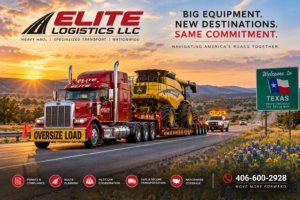
Elite Logistics provides oversized farm equipment transport with permit coordination, route planning, pilot car support, and nationwide heavy haul service. Call 406-600-2928.
What Counts as an “Oversize” Load
Most states use a similar baseline, but the exact cutoffs vary enough to matter:
- Width: Over 8’6″ in nearly every state
- Height: Typically 13’6″–14′, though a handful of states (Alaska, Idaho) allow up to 14′ before a permit is required
- Length: Usually 48’–53′ for the trailer itself, with total combination length limits ranging higher
- Weight: 80,000 lbs gross vehicle weight is the federal baseline, though some states (Texas, for example) allow higher GVW with permits
Machinery haulers hit these thresholds constantly — a wide combine head, a tall excavator, or a long piece of pipe-hauling equipment can trip one or more limits even on a load that looks routine. Anything beyond these numbers is classified as non-divisible cargo, meaning it can’t be broken down to meet standard limits, which is what triggers the permit requirement in the first place.
Why Multi-State Permitting Gets Complicated
A single-state permit is straightforward: one DOT, one set of rules, one fee. A multi-state route means coordinating separate permits from every state the load crosses — and each one comes with its own:
- Dimension and weight thresholds for when escorts become mandatory
- Travel curfews (many states restrict oversize moves at night, on weekends, or around holidays)
- Route restrictions tied to bridge clearances and weight-rated structures
- Fee structures, which can range from $15 to over $1,000 depending on the state and load classification
- Insurance minimums, which some states set specifically for oversize/overweight carriers
None of these are federally standardized. The FMCSA sets general size and weight guidance, but permitting authority sits with each state DOT, which is why a load moving from Montana to Texas might need four or five separate approvals before it ever leaves the yard.
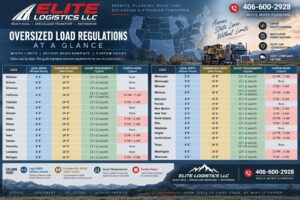
Oversized Load Regulations at a Glance — Elite Logistics LLC provides nationwide heavy haul route planning, multi-state permit support, pilot car coordination, and specialized transportation services. Call 406-600-2928.
Escort and Pilot Car Requirements Vary Widely
Escort vehicle rules are one of the biggest trip-up points on multi-state hauls, because thresholds aren’t consistent:
- Many states require a front escort once a load exceeds roughly 12′ wide, and a rear escort past 14’–16’6″
- Montana, for example, requires one rear escort on the interstate at 16’6″ wide, but a front escort on non-interstate routes starting at 12’6″
- Superloads — generally over 20′ wide or 250,000 lbs — can trigger law enforcement escorts in addition to pilot cars in several states
- Height-restricted routes may require a pole car ahead of the load to check overhead clearances
Because these thresholds don’t line up state to state, a load that needs zero escorts in one state might require two by the time it crosses into the next. Route planning has to account for the strictest state on the itinerary, not just the average.
Common Multi-State Permitting Mistakes
- Applying too late. Some states require lead time of a week or more for superloads or loads needing engineering review on bridges.
- Assuming permits transfer. A permit issued in one state has zero authority in the next — each state requires its own application, fee, and approval.
- Missing curfew windows. Holiday and weekend travel bans (common in Texas and several other states) can strand a load if the route wasn’t planned around them.
- Underestimating insurance minimums. Some states set coverage requirements specifically tied to load width or height, separate from your standard cargo policy.
- Skipping a route survey. Permits typically state the carrier is responsible for verifying bridge and overpass clearances — the permit doesn’t guarantee them.
Working With a Permit Service vs. Filing Direct
For a single-state, one-off move, filing directly with the state DOT is manageable. For recurring multi-state machinery hauls, most carriers lean on a permit service or a broker relationship that already has these variances mapped — which is part of why working with an established freight partner matters as much as the truck and trailer. It’s also where working with an experienced heavy haul carrier pays off: route planning, permit coordination, and escort scheduling happen before the load ever gets to the highway, not after a weigh station flags a problem.
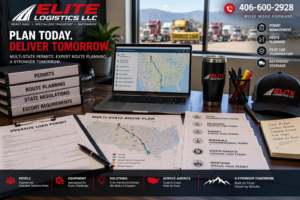
Elite Logistics LLC handles multi-state permits, heavy haul route planning, pilot car coordination, and nationwide oversized load transportation. Call 406-600-2928.
Montana-Specific Considerations for Machinery Haulers
For loads originating in or moving through Montana, a few state-specific rules matter:
- Montana’s legal (no-permit) limits are 8’6″ wide, 14′ tall, and 75′ total length including overhang
- Permits can be filed through Montana’s ePASS online system or by phone through the MDT permit office
- Escort thresholds: one rear escort at 16’6″ wide on the interstate; front escort required at 12’6″ on non-interstate routes
- A minimum $1 million combined single-limit liability policy is required for permitted moves
- Montana allows interstate agreements with other states for permit issuance, but each state still requires its own separate application
This matters for ag equipment moves especially — combines, balers, and tractors headed out of Montana toward neighboring states often sit right at these width and height thresholds. If you’re planning a machinery move, our guides on hauling a combine harvester and hay baler transport cover the equipment-specific prep that pairs with the permitting side.
Building a Multi-State Permit Checklist
- Confirm final dimensions and weight, including any overhang
- Map every state the route crosses and pull current thresholds for each
- Identify escort and pilot car requirements per state, not just the strictest one
- Check holiday, weekend, and curfew restrictions along the entire route
- Verify bridge and overpass clearances independently of the permit
- Confirm insurance minimums meet the highest requirement on the route
- File with enough lead time for the slowest-processing state involved
- Keep physical or electronic copies of every state’s permit in the cab
FAQs
Do I need a separate permit for every state my load crosses?
Yes. Oversize and overweight permits are issued at the state level, so a route through four states requires four separate permits, even if the load dimensions don’t change.
What’s the difference between an oversize permit and a superload permit?
A standard oversize permit covers loads that exceed normal dimension or weight limits but can still travel under routine conditions. A superload permit applies to much larger loads — generally over 20′ wide or 250,000 lbs — and often requires engineering review of bridges along the route, plus law enforcement escorts.
How far in advance should I apply for multi-state permits?
It depends on the states involved, but plan for at least 3–5 business days for standard oversize permits and up to two weeks for superloads requiring bridge analysis. Some states process same-day; others don’t.
Do oversize permit rules apply to agricultural equipment differently?
Some states offer seasonal exemptions or simplified permitting for ag equipment moves, particularly during planting and harvest windows. These exemptions are state-specific and don’t carry over to neighboring states.
What happens if I don’t have the right permit at a weigh station?
Expect fines, potential impoundment of the load until a permit is obtained, and possible delays that can run into days depending on the state’s processing time. Some states also apply per-mile or per-pound overweight penalties on top of the base fine.
Can one permit service handle applications across all the states on my route?
Yes — this is the main advantage of using a permit service or an experienced carrier partner. They file with each state directly, track differing requirements, and flag route conflicts before the load moves, rather than the carrier managing five separate DOT relationships alone.
Do escort vehicle requirements ever conflict between adjacent states?
Occasionally. A load might need zero escorts in one state and two (front and rear) in the next, based purely on crossing a state line. Route planning has to account for every state’s threshold individually, not an average across the trip.
Moving oversized machinery across state lines takes more than a good truck and trailer — it takes a permitting process that accounts for every DOT’s rules on the route, not just the one where the load starts. Elite Logistics coordinates multi-state permitting, escort scheduling, and route planning for machinery and heavy equipment haulers moving through Montana and beyond. Request a quote to get your next oversize move planned right.