
Shipping a Hay Baler
Shipping a Hay Baler: What You Need to Know
If you’ve shipped a tractor or a combine before, you might assume a hay baler is the easy one. Sometimes it is. But baler dimensions vary more than people expect — a compact round baler and a 16-foot industrial in-line square baler are barely the same category of freight — and that variance is exactly where shipping quotes, trailer choices, and permit questions go wrong. This guide breaks down what actually drives the cost and complexity of shipping a hay baler, whether you’re a hay producer moving equipment between fields, a dealer delivering a new unit, or a buyer hauling one home from an auction.
A round hay baler strapped and chained to DOT specification before departure.
Round Balers vs. Square Balers: Why Dimensions Matter
Hay balers fall into two broad categories, and each ships differently.
Round Balers
Round balers are the most common hay equipment on the road. Most fall between 8 and 10 feet wide and roughly 8 to 9 feet tall — comfortably within standard legal limits for a flatbed trailer. They’re light relative to other farm equipment, typically 4,000 to 7,000 lbs empty, which keeps freight costs lower and loading straightforward with a simple drive-up ramp.

Get a fast freight quote from Elite Logistics LLC — flatbed, heavy haul, hot shot, and specialized trucking across the U.S.https://elitelogistics1.com/request-a-quote/
Square Balers
Square balers, especially large industrial models that produce 3×3 or 3×4 bales, are a different story. These machines can stretch 14 to 18 feet long including the tongue, weigh upward of 15,000 to 25,000 lbs, and — if shipped with an attached accumulator or bale wagon — can push width past the standard 8.5-foot legal limit. That’s the line where a routine flatbed shipment turns into an oversize load requiring permits.
Before requesting a quote, measure your baler’s actual transport width, length, and height with any attachments in their transport (not operating) position. A few inches can be the difference between a same-day flatbed dispatch and a multi-day permitted move.
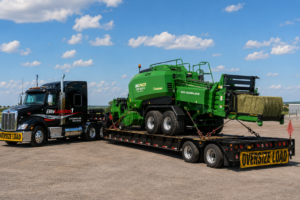
Industrial square balers with attachments often require a step-deck trailer and oversize permit review.
Choosing the Right Trailer for Your Hay Baler
Most hay equipment moves on one of two trailer types, and picking correctly affects both cost and lead time.
Standard Flatbed Trailers
The default choice for round balers and most small-to-mid-size square balers. A 48- or 53-foot flatbed trailer loads fast via ramp, costs less to dispatch, and is widely available — which usually means a faster pickup window. If your baler fits within roughly 8.5 feet wide and 13.5 feet tall, a flatbed is almost always the right call.
Step-Deck Trailers
When a baler’s height with the bale chamber raised, or a square baler’s tongue-up transport position, would put it over the legal height limit on a standard flatbed deck, a step-deck trailer’s lower deck height buys back that clearance without triggering a height permit. This is the more common scenario with larger square balers and balers shipped alongside an accumulator.
For context on how trailer choice affects pricing across all farm equipment types, see our farm equipment shipping cost guide.
What Drives Hay Baler Shipping Costs
Quotes for hay baler transport are built from the same core factors as any flatbed farm equipment move:
- Distance. The single biggest driver of total cost — and the one most easily controlled by booking lead time, since rushed last-minute loads cost more.
- Equipment weight and dimensions. A 5,000 lb round baler ships far cheaper than a 20,000 lb square baler requiring a step-deck.
- Permit requirements. Oversize loads add permit fees and 24–48 hours of lead time per state crossed.
- Seasonal demand. Hay equipment transport requests spike sharply in late spring and again before second/third cutting — booking outside peak windows can mean better rates and faster pickup.
- Single-unit vs. multi-unit loads. Shipping a baler alongside a rake, tedder, or mower on the same trailer reduces the per-unit cost. See our guide to LTL vs. FTL freight for how consolidated loads are priced.
If you’re also shipping a tractor to pull the baler at its destination, our tractor shipping cost guide breaks down those numbers separately so you can budget the full move.
Do You Need a Permit to Ship a Hay Baler?
For most round balers and standard square balers, the answer is no — they ship under standard legal limits with no special permitting. But there are three common situations where a hay baler shipment crosses into oversize territory:
- Wide accumulators or bale wagons attached for transport rather than detached and crated separately.
- Industrial in-line square balers with full bale-handling systems still mounted.
- Multi-unit hay equipment loads where stacked or side-by-side configurations push total width or height over standard thresholds.
Every state sets its own oversize thresholds, and crossing multiple states on one move means clearing each state’s permit process individually. Elite Logistics LLC’s in-house permit team handles this end-to-end as part of our broader farm equipment hauling services, the same way we manage permits for combines and large planters.
Curious how oversize rules apply across all of agriculture, not just hay equipment? Our FMCSA compliance guide covers the federal side of load securement and weight regulations that apply to every shipment we run.
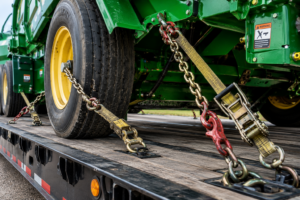
Proper chain and binder securement is required on every farm equipment load, regardless of size.
Preparing a Hay Baler for Shipment: A Quick Checklist
A little prep work the day before pickup keeps loading fast and avoids delays:
- Remove loose twine, net wrap, or plastic film rolls and either ship them separately or secure them tightly so nothing comes loose in transit.
- Lower the bale chamber or tailgate to its transport position if your model allows it — this can reduce overall height and avoid a step-deck requirement.
- Check tire pressure and condition on balers with their own wheels, since a flat tire on pickup day delays loading.
- Disconnect any trailing hitch pins or PTO shafts that aren’t needed for transport.
- Photograph the baler from all four sides before the driver arrives, for your own records and condition documentation.
- Clear a straight, firm approach path for the truck and trailer — soft field access or tight gate clearances should be flagged to dispatch in advance.
For a side-by-side comparison of what this looks like on larger equipment, our combine harvester transport checklist covers the same principles at a bigger scale.
Timing It Right: Seasonal Demand for Hay Equipment Transport
Hay equipment shipping follows the cutting calendar. Demand for balers, rakes, and tedders climbs sharply in the weeks before first cutting in late spring, and again ahead of second and third cuttings through summer. Booking your shipment 7–10 business days ahead of these windows — rather than the week you actually need the equipment in the field — generally means better rate availability and a wider pool of trucks to choose from.
Why Ship Your Hay Baler with Elite Logistics LLC
Elite Logistics LLC moves hay equipment the same way we move every piece of agricultural machinery: as an asset-based carrier network that owns the relationship with your freight from pickup to delivery, not a broker who hands it off to an unknown truck. Our team understands the seasonal pressure behind a hay equipment move — a baler that’s late for first cutting isn’t a minor inconvenience, it’s a missed window. That’s why we quote fast, dispatch from a nationwide network, and handle permit paperwork in-house when your baler crosses into oversize territory.
Whether you’re moving a single round baler across the state or a multi-unit hay equipment load across the country, our farm equipment hauling team can get you a fast, all-inclusive quote.
Request a Free Hay Baler Shipping Quote →
Frequently Asked Questions
How much does it cost to ship a hay baler?
Hay baler shipping costs typically run $2–$4 per mile for standard flatbed moves, depending on distance, baler size, fuel rates, and whether a step-deck trailer is needed for taller units. Most in-state moves run a few hundred dollars; long-haul, cross-country shipments can reach the low thousands. See our full farm equipment shipping cost guide for a detailed breakdown.
Does a hay baler need a special permit to transport?
Most standard round and small square balers fit within legal width and height limits and don’t require oversize permits. Large industrial square balers — especially with an accumulator or bale wagon attached — can exceed 8.5 feet wide and may require a permit depending on the state.
What trailer is used to ship a hay baler?
Most hay balers ship on a standard 48- or 53-foot flatbed trailer. Taller round balers or large square balers with raised components sometimes require a step-deck trailer for extra vertical clearance.
How do I prepare a hay baler for shipping?
Remove or secure twine and net wrap rolls, lower the bale chamber or tailgate if possible, check tire pressure, disconnect any trailing hitch components, and photograph the baler from all angles before pickup.
Related reading: Farm Equipment Hauling Services | How Much Does It Cost to Ship a Tractor? | Combine Harvester Transport Checklist | Flatbed Trucking Services