
Our Blogs
Explore expert tips, industry updates, and practical advice to make smarter logistics decisions.
Specialized Freight Rates and Requirements 2026
Specialized Freight Rates and Requirements 2026
Ask three carriers what specialized freight costs and you’ll get three different answers, none of them wrong. That’s because “specialized freight” isn’t one category — it’s oversized machinery on an RGN, a hazmat tanker running a PHMSA-restricted route, and a step deck load that just barely needs to duck under a bridge, all lumped under one label. Each of those has its own rate structure, its own permit rules, and its own way of blowing up a budget if you don’t plan for it.
This guide breaks down what specialized freight actually costs in 2026, what triggers a permit versus a full route survey, and how to read a quote so you’re not surprised by a line item three days before pickup.
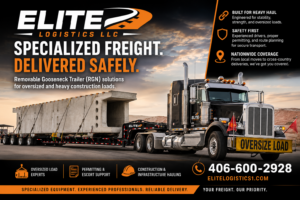
Elite Logistics provides nationwide oversized construction material transportation using removable gooseneck (RGN) trailers, delivering safe, reliable heavy-haul solutions for infrastructure, commercial, and industrial projects. Call 406-600-2928.
What Counts as Specialized Freight?
Specialized freight covers anything that falls outside standard dry van or general flatbed capacity — cargo that’s too big, too heavy, too hazardous, or too temperature-sensitive for a standard trailer. At Elite Logistics LLC, that includes:
- Oversized and overweight loads — construction equipment, industrial machinery, wind turbine components
- Hazmat freight — chemicals, fuel, compressed gases, anything requiring DOT hazard-class placarding
- Heavy haul — loads exceeding standard axle weight limits that need multi-axle trailers
- Temperature-controlled specialty cargo — pharmaceuticals, biologics, and other freight needing tighter cold chain control than standard refrigerated trucking
- High-value or white-glove freight — cargo requiring dedicated trailers, no co-mingling, and enhanced tracking
The common thread: every one of these requires equipment, permits, or driver credentials that a standard truckload carrier doesn’t have on hand.
Specialized Freight Rates by Equipment Type (2026)
These are national per-mile ranges. Your actual rate depends on lane, season, load weight, and whether permits or escorts are required.
Step deck (drop deck): roughly $2.35–$3.00/mile on long-haul lanes, running higher — $3.00–$5.00+/mile — on shorter regional moves. Step decks handle freight up to about 10 feet tall without triggering overheight permits, which makes them the default choice for equipment that’s too tall for a standard flatbed but doesn’t need a lowboy.
RGN and lowboy (double drop): base rates start around $3.40/mile, with a $1,000 minimum common on shorter moves. Lowboys sit 18–24 inches off the ground, giving the clearance needed for tall equipment — excavators, dozers, cranes — that would exceed height limits on a step deck.
Oversized/overweight permitted loads: once a load requires a permit, pricing typically shifts from a flat per-mile rate to a day-rate or line-item structure — commonly $4.00–$8.00+/mile once permits, escorts, and routing complexity are factored in. Super loads (generally over 150,000 lbs or 16+ feet wide) run considerably higher due to mandatory engineering reviews.
Hazmat and tanker freight: rates vary by hazard class and endorsement required. General hazmat premiums run roughly $0.20–$1.00+ per mile above standard freight, or $50–$300+ per load. Liquid chemical tankers requiring both hazmat (H) and tanker (N) endorsements — the combined “X” endorsement — command the highest premiums, often 20–30% above general freight.
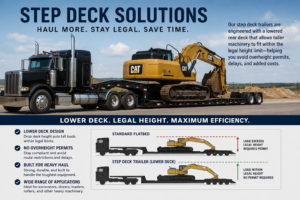
Step deck trailers reduce overall load height, making them an ideal solution for transporting tall construction equipment while minimizing the need for overheight permits.
What Drives Specialized Freight Costs
Weight and axle configuration. Heavier loads need more axles to distribute weight legally, and each added axle changes the trailer’s capacity, fuel burn, and — often — the permit category the load falls into.
Permits. Any load exceeding federal baseline dimensions — 8’6″ wide, 13’6″ tall, 48–65 feet long depending on configuration, or 80,000 lbs gross vehicle weight — needs an oversize or overweight permit in every state it crosses. Standard single-trip permits run roughly $15–$100 per state; super load permits requiring engineering review can run $200–$2,000+ per state.
Pilot car escorts. Wide, tall, or long loads often require one or more escort vehicles. Expect $400–$800 per day, per escort — sometimes both a front and rear car depending on state rules and load dimensions.
Route surveys. For the largest loads, carriers may need to survey the actual route for bridge clearances, weight limits, and turn radii before the truck ever moves. Survey costs typically run $500–$2,000+.
Hazard classification. For hazmat freight, the federal placarding threshold is 1,001 pounds aggregate gross weight for most material categories (Table 2 under 49 CFR 172.504) — but Table 1 materials, like certain explosives and poison-inhalation-hazard gases, require placarding at any quantity. Bulk containers, like tankers, must be placarded regardless of how full they are.
Loading conditions. Non-running equipment that needs a crane or winch to load adds cost even on a short haul. A site that can’t accommodate standard loading equipment changes the whole plan.
Season. Specialized and heavy haul rates typically run 10–20% higher March through September — peak construction season — and are lowest December through February.
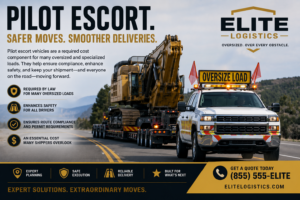
Pilot escort vehicles are often required for oversized freight shipments, helping protect the public, maintain regulatory compliance, and safely guide heavy equipment to its destination.
Oversized Load Permit Thresholds
A permit is required once a load exceeds any one of these federal baseline dimensions — even if every other measurement is legal:
| Dimension | Federal Threshold |
|---|---|
| Width | 8’6″ (102 inches) |
| Height | 13’6″ (most states; some allow 14′ on designated routes) |
| Length (single vehicle) | 48 feet |
| Length (combination) | 65 feet |
| Weight (GVW) | 80,000 lbs |
States administer permits individually, and a load must be permitted separately for every state it crosses. Height limits, secondary-road width restrictions, and annual-versus-single-trip permit options all vary — which is exactly why route planning happens before the trailer is selected, not after.
Hazmat Requirements Specific to Specialized Freight
Hazmat freight carries its own compliance layer on top of standard trucking regulations:
- Drivers need a CDL with an H (hazmat) endorsement, and an N (tanker) endorsement for liquid bulk loads — combined as an X endorsement for tanker hazmat work
- TSA background checks are required for the hazmat endorsement itself
- PHMSA-designated preferred routes may apply, avoiding tunnels, densely populated areas, and other restricted corridors — sometimes adding 10–30% more miles
- Complete shipping papers are required for any regulated hazmat quantity, even below the placarding threshold
For more detail on how these requirements apply lane by lane, see our hazmat trucking requirements guide.
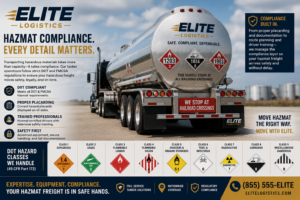
Elite Logistics tanker truck equipped with required DOT hazard placards, demonstrating the compliance standards that govern the safe transportation of hazardous materials throughout the United States.
Getting an Accurate Specialized Freight Quote
A specialized freight quote worth trusting breaks out line by line: base linehaul, permit fees by state, escort costs if required, fuel surcharge, and any loading-equipment charges. If a quote comes back as one flat number with no breakdown, ask for the detail — it’s the only way to know what’s negotiable and what’s fixed regulatory cost.
The information that speeds up an accurate quote:
- Exact dimensions (length, width, height) and weight of the loaded trailer
- Origin and destination, including any access restrictions at either site
- Whether the equipment is running or requires crane/winch loading
- Hazard class and quantity, if applicable
- Timeline flexibility — rigid delivery windows on oversized freight often carry a premium
Elite Logistics LLC handles the full range of specialized freight — flatbed, heavy haul, and hot shot — with permit, escort, and route-survey coordination handled in-house so shippers get one line-item quote instead of piecing it together themselves.
FAQ
What’s the difference between oversized and overweight freight?
Oversized refers to a load exceeding legal length, width, or height limits. Overweight refers specifically to exceeding gross vehicle weight limits (generally 80,000 lbs). A load can be one, the other, or both — and each triggers its own permit requirements.
How much does an oversized load permit cost?
Standard single-trip permits typically run $15–$100 per state depending on dimensions. Super load permits — generally over 150,000 lbs or 16+ feet wide — require engineering review and can run $200–$2,000+ per state.
Do all specialized loads need a pilot car escort?
No. Escort requirements depend on width, height, and length thresholds that vary by state — commonly triggered around 12–14 feet wide. Some states require both a front and rear escort on the widest or longest loads.
What’s the weight threshold for hazmat placarding?
For most hazardous material categories (Table 2 under federal regulation), placarding is required once the aggregate gross weight reaches 1,001 pounds. Table 1 materials — including certain explosives and poison-inhalation hazards — require placarding at any quantity, with no minimum threshold.
Is a step deck or an RGN the right trailer for my load?
Step decks handle freight up to about 10 feet tall without an over height permit and cost less per mile. RGNs and lowboys sit lower to the ground (18–24 inches) for taller equipment but run a higher base rate. If the load fits on a step deck, there’s usually no reason to pay for an RGN.
How far in advance should I book specialized freight?
Superload and multi-state permitted moves can take 2–6 weeks for permit processing and route survey approval. Standard oversized loads within a single permit tier often move in 1–5 business days once permits clear — but booking early avoids scrambling if a route survey turns up a bridge or clearance issue.
Do specialized freight rates change by season?
Yes. Heavy haul and specialized rates typically run 10–20% higher during peak construction season (spring through early fall) and are lowest in the December–February off-season, when equipment-moving demand drops.