
Our Blogs
Explore expert tips, industry updates, and practical advice to make smarter logistics decisions.
Produce Trucking Rates & Requirements
Produce Trucking Rates & Requirements: What Shippers Need to Know in 2026
A pallet of strawberries doesn’t get a second chance. Neither does a load of romaine sitting at 38°F when it needed to be at 34°F. In produce trucking, the freight itself is the deadline — every hour it sits, every degree it drifts, is money leaving the truck before it ever reaches the dock. That makes produce one of the least forgiving categories in all of freight, and one of the most misunderstood when it comes to what a load should actually cost and what a compliant carrier is required to do.
This guide breaks down current produce trucking rates for 2026, what drives them up or down by season and lane, and the produce trucking requirements — from FSMA’s Sanitary Transportation Rule to commodity-specific temperature ranges — that separate a carrier who can move perishables safely from one who just owns a reefer trailer.
Quick Answer: National reefer spot rates are running roughly $2.28–$3.12 per mile in 2026, but produce-heavy lanes out of California’s Coachella, Imperial, and Salinas growing regions regularly run higher during peak harvest as reefer capacity tightens. Beyond rate, produce trucking is governed by the FDA’s Sanitary Transportation of Human and Animal Food Rule, which sets requirements for vehicle sanitation, temperature control, documentation, and carrier training — most fresh produce needs to move at 32°F–36°F with continuous temperature logging.
Pre-cooling starts before the first pallet ever loads.
What Is Produce Trucking?
Produce trucking is the specialized branch of temperature-controlled freight dedicated to moving fresh fruits, vegetables, leafy greens, herbs, and other perishable farm commodities from growing regions and packinghouses to distribution centers, grocery chains, and food service operators. Unlike standard dry van freight, it demands precise temperature and humidity control, ethylene management between certain fruit and vegetable types, tight transit windows tied to harvest schedules, and documented food-safety compliance from pickup to delivery.
Almost all produce trucking runs on refrigerated trailers (reefers), though short, urgent runs — a packinghouse short one truck during peak harvest, or a same-day delivery to a regional distributor — sometimes move via hot shot trucking when a full reefer isn’t available or isn’t needed for the volume.
From field to trailer — timing is everything in produce freight.
Produce Trucking Rates in 2026: What You’ll Actually Pay
Produce trucking rates are quoted almost universally on refrigerated trailers, so reefer spot and contract data is the closest proxy shippers have. As of early-to-mid 2026, national reefer spot rates are averaging in the $2.28–$3.12 per mile range depending on the data source and week, with contract rates typically running $0.15–$0.20 per mile above spot on established lanes.
Those national averages hide the real story for produce specifically. USDA’s Agricultural Marketing Service tracks refrigerated truck rates by growing region and destination, and produce lanes routinely diverge from general reefer freight because of harvest timing. Lanes out of California’s Imperial and Coachella Valleys, the Salinas and Santa Maria districts, and the Rio Grande Valley all see rate spikes tied directly to harvest windows for specific crops — lettuce, strawberries, celery, and citrus each have their own seasonal curve that pulls reefer capacity toward that region and away from everywhere else.
| Equipment Type | 2026 Spot Rate Range (per mile) | Typical Use in Produce Freight |
|---|---|---|
| Reefer (Refrigerated) | $2.28 – $3.12 | Standard for full truckload fresh produce |
| Dry Van | $1.80 – $2.68 | Only for shelf-stable produce not requiring temp control |
| Hot Shot | $2.00 – $3.50 | Urgent, smaller-volume produce runs |
| Flatbed | $2.10 – $3.46 | Rarely used for produce; bulk onions/potatoes in some regions |
The takeaway for shippers: a quoted rate that looks competitive against national reefer averages can still be a bad number if it doesn’t reflect what capacity actually looks like on your specific origin lane during your specific harvest window. See our full 2026 freight shipping rates guide for how rate-building works across all equipment types.
What Drives Produce Trucking Rates Up or Down
Harvest seasonality. Produce season isn’t one season — it’s a rolling series of regional harvests from late winter through fall. Rates climb as harvest approaches in a given growing region and reefer trucks reposition toward it, then soften once that window closes.
Reefer capacity and the driver shortage. The broader trucking capacity crunch is compounding produce-specific tightness. Our 2026 trucking industry crisis breakdown covers the driver shortage and regulatory pressure squeezing carrier capacity across every equipment type, reefer included.
Fuel burn. A reefer unit runs its refrigeration compressor constantly, independent of the truck’s engine, which adds fuel cost on top of standard linehaul diesel — more in summer heat when the unit works harder to hold temperature.
Deadhead miles. Produce-growing regions don’t always have strong backhaul freight in the opposite direction. A carrier pricing a produce lane honestly builds empty return miles into the outbound rate rather than eating that cost — which is one reason a bargain-basement quote on a produce lane deserves scrutiny.
Cross-border and tariff exposure. Lanes moving produce from Mexico through crossings like Nogales and Calexico are sensitive to tariff policy and border wait times, and reefer rejection rates on these lanes have run elevated in 2026 as a result.
Continuous temperature logging is the standard, not the exception.
Produce Trucking Requirements: The FSMA Sanitary Transportation Rule
Rate is only half the equation. The other half is compliance, and for produce that means the FDA’s Sanitary Transportation of Human and Animal Food Rule, part of the Food Safety Modernization Act and codified at 21 CFR Part 1, Subpart O. The rule applies to shippers, loaders, carriers, and receivers moving food — including fresh produce — by motor vehicle, and it sets requirements in four areas:
- Vehicle and equipment design: Trailers and equipment must be cleanable, properly maintained, and capable of adequate temperature control — no corroded surfaces, no broken pallets that could puncture packaging.
- Transportation operations: Effective measures to prevent cross-contact between raw and ready-to-eat product, proper pre-cooling before loading, and maintaining the operating temperature the shipper specifies in writing.
- Training: When a carrier contractually accepts responsibility for sanitary conditions, its personnel must be trained in sanitary transportation practices — and that training must be documented.
- Records: Temperature logs, cleaning records, and training documentation must be retained for at least 12 months and made available to the FDA within 24 hours if requested.
Under the rule, the shipper carries primary responsibility for specifying the required operating temperature in writing, but the carrier is on the hook for demonstrating — with logs, not just a verbal assurance — that the load was held within that range for the entire transportation operation. Real-time electronic monitoring isn’t mandatory, but it’s become the practical standard because it’s the only reliable way to produce that proof on request.
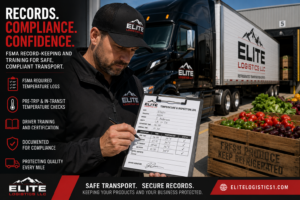
Documentation isn’t paperwork — it’s proof of compliance.
Temperature, Humidity & Load Planning Requirements
Beyond the regulatory floor, produce has commodity-specific handling requirements that a carrier needs to plan around, not discover mid-route:
- Leafy greens and herbs (lettuce, spinach, kale, cilantro): typically 32°F–36°F with controlled humidity and airflow — some of the most perishable freight on the road.
- Fresh vegetables (tomatoes, peppers, cucumbers, brassicas): careful load planning to prevent bruising, plus ethylene exposure control since several vegetable types are ethylene-sensitive.
- Ethylene-sensitive fruit (melons, stone fruit): may require climate separation from ethylene-producing commodities in mixed loads.
- Pre-cooling: the trailer must reach its target set-point before loading begins — loading into a warm trailer creates a temperature deficit the reefer unit may never fully recover from in transit.
Multi-commodity loads add another layer of planning: a carrier moving a mixed pallet of produce needs to know which commodities can legally and practically share a trailer without compromising quality on either end of the load.
Produce Trucking vs. Other Equipment Types
Reefer is the default for a reason, but it isn’t automatic. Shelf-stable items like winter squash, onions, or potatoes sometimes move on flatbed or dry van depending on season and distance, and urgent, smaller-volume produce runs — a packinghouse one truck short during peak harvest — often make more sense on a hot shot than waiting on a full reefer trailer. If you’re weighing equipment types for a specific load, our Dry Van vs. Reefer vs. Flatbed guide breaks down the decision in more detail.
How to Choose a Produce Trucking Partner
A handful of questions separate a carrier built for perishables from a generalist who happens to own a reefer:
- Can they provide electronic temperature logs on request, not just a verbal “it was fine”?
- Do they pre-cool trailers before loading as standard practice, or only when asked?
- Do they understand your commodity’s specific temperature and humidity range, not just “cold”?
- Can they speak to how they handle FSMA documentation and training requirements?
- Do they have real experience in your specific growing region and its harvest calendar?
- What’s their plan for deadhead miles out of your region — is it priced honestly into the rate, or is it a surprise accessorial later?
It’s also worth asking how a carrier retains records. Under the Sanitary Transportation Rule, temperature and cleaning records need to be kept for at least 12 months and produced within 24 hours of an FDA request — a carrier who can’t answer that clearly in a sales conversation is unlikely to have the system in place when it actually matters.
Montana’s Produce Corridor
Montana isn’t the first state that comes to mind for produce freight, but the Gallatin Valley and surrounding agricultural corridors move real volume in local and regional specialty crops, farmers’ market supply chains, and outbound loads tied to the broader Northern Rockies growing season. That volume competes for the same reefer capacity as the rest of the country during peak summer months, which is exactly when national harvest activity elsewhere is also pulling trucks away from the region. Shippers moving produce out of Montana benefit from working with a carrier who tracks both the local pickup and the national capacity picture at the same time.
How Elite Logistics LLC Handles Produce Trucking
Elite Logistics LLC operates as a dedicated produce trucking partner out of Manhattan, Montana, moving fresh vegetables, leafy greens, and farm commodities on a refrigerated trucking fleet built around pre-cooling protocols, continuous temperature logging, and load plans that respect ethylene sensitivity and harvest timing rather than treating every pallet the same. As a Trinity Logistics partner, we build produce coverage into the same freight network that supports Montana’s agricultural corridors during peak summer demand — when reefer capacity tightens fastest and the cost of choosing the wrong carrier is highest.
Need cargo coverage on a high-value produce load? Our freight insurance guide for long-haul shipments covers what’s typically in place and what shippers should confirm before a load rolls.

Every mile matters more when the cargo can’t wait.
Frequently Asked Questions
What is a typical produce trucking rate per mile in 2026?
National reefer spot rates are running roughly $2.28–$3.12 per mile in 2026, though produce-specific lanes out of peak growing regions like California’s Coachella and Imperial Valleys often price higher during harvest season due to tight reefer capacity.
What temperature should produce be shipped at?
It depends on the commodity. Most leafy greens and many vegetables ship at 32°F–36°F, while some fruits require warmer set points to avoid chilling injury. The shipper is required to specify the operating temperature to the carrier in writing under the FSMA Sanitary Transportation Rule.
Who is responsible for temperature compliance — the shipper or the carrier?
Both. The shipper must specify the required operating temperature in writing. The carrier is responsible for maintaining that temperature throughout transit and must be able to demonstrate compliance with documentation if the shipper or receiver requests it.
Does all produce require a refrigerated trailer?
No. Some shelf-stable crops like onions, potatoes, and winter squash can move on flatbed or dry van depending on season and market. Most fresh fruits and vegetables require reefer transport to maintain quality and meet food safety requirements.
Why do produce trucking rates spike during harvest season?
Reefer trucks reposition toward active growing regions as harvest approaches, pulling capacity away from other lanes. Combined with limited backhaul freight out of many agricultural regions, this seasonal capacity shift is the single biggest driver of produce rate volatility.
Ready to move your next produce load? Request a freight quote from Elite Logistics LLC or call (406) 600-2928 to talk through your lane, commodity, and timeline with our dispatch team.