
How to Prepare a Combine Harvester for Transport: Complete Pre-Shipping Checklist
How to Prepare a Combine Harvester for Transport: Complete Pre-Shipping Checklist
By Elite Logistics LLC | Published June 25, 2026 | 8 min read

Get a fast freight quote from Elite Logistics LLC — flatbed, heavy haul, hot shot, and specialized trucking across the U.S.
A combine harvester sitting one state away from where it needs to be on September 1st is not a logistics problem you want to discover on August 28th. Looking at How to Prepare a Combine Harvester for Transport: Complete Pre-Shipping Checklist Unlike a tractor or a baler, a combine can’t just get strapped down and rolled — it has to be prepared for transport, and skipping a step in that prep is exactly how loads get stuck at a weigh station, denied a permit, or damaged in transit.
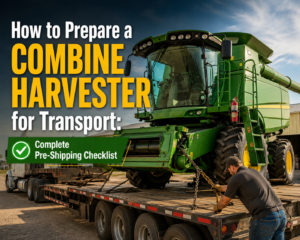
A combine harvester is securely loaded onto a flatbed trailer, illustrating the essential steps for preparing farm equipment for safe transport. This guide covers the complete pre-shipping checklist to help ensure a smooth and compliant hauling process.
This checklist walks through exactly what needs to happen before a combine harvester leaves the field, so your shipment moves on schedule the first time.
Why Combine Prep Isn’t Optional
A current-generation combine — a Case IH Axial-Flow, a John Deere X9, an Agco Gleaner — is built to harvest, not to travel. With the header attached and the grain tank cover raised, most combines exceed standard legal width, height, or both. That means the difference between a smooth interstate move and a rejected permit application often comes down to whether the machine was properly prepped before the carrier ever showed up.
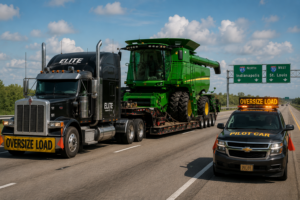
An Elite Logistics LLC semi tractor-trailer transports an oversized combine harvester on a heavy-haul trailer while a pilot escort vehicle leads the convoy along the interstate. Professional route planning, oversize permits, and escort coordination help ensure the safe and compliant transport of agricultural equipment across the United States.
Three things go wrong when prep gets skipped:
- Permit delays. States issue oversize permits based on the dimensions you submit. If the header is still attached and nobody accounted for it, the permit is wrong before the truck leaves the yard.
- Load-damage claims. Grain left in the tank shifts weight during transport and stresses tie-down points that were never rated for it.
- Failed inspections. DOT officers checking an oversize load at a weigh station expect to see a machine prepared to spec. A combine that doesn’t match its permit gets pulled off the road.
The Pre-Shipping Checklist
1. Drain the Grain Tank Completely
Residual grain adds unaccounted weight and shifts during transport, which can throw off axle weight distribution on a multi-axle trailer. Drain the tank fully and sweep out any remaining material before the carrier arrives.
2. Detach the Header
The header is almost always removed and shipped separately on its own header trailer or cart. This single step is usually what brings a combine’s transport width back within range of a standard oversize permit instead of a super-load permit. Confirm with your carrier whether the header travels on the same load or as a separate shipment.
3. Lower All Raised Platforms and Folding Components
Grain tank extensions, folding unloading augers, and any adjustable platforms need to be in their lowest, locked transport position. Anything left raised adds height that wasn’t accounted for in the permit application.
4. Document Exact Dimensions and Weight
Before requesting a quote, have these numbers ready:
- Make, model, and year
- Transport length, width, and height with header removed
- Total weight (tank empty)
- Any non-standard attachments shipping with the unit
Carriers use this information to determine trailer type — flatbed, step-deck, or removable gooseneck (RGN) — and to file accurate permits. Getting these numbers wrong is the single biggest cause of mid-route permit problems.
5. Secure or Remove Loose Components
Mirrors, ladders, antennas, and anything not rated to withstand highway speeds should be removed, folded, or independently secured. Anything that can move or detach in transit is a liability for the load and for other drivers on the road.
6. Confirm Lien Status and Documentation
If the combine has an active lien, most carriers will require a release letter from the lender before they can legally transport it. Sort this out before booking, not the morning of pickup.
7. Plan for the Right Trailer Type
Most self-propelled combines load via a removable gooseneck (RGN) trailer, which lowers to ground level so the machine can be driven on rather than winched up a ramp. Smaller or older combines may ship on a step-deck. Confirm trailer type with your carrier based on the dimensions you documented in step 4.
8. Build in Permit Lead Time
Oversize loads require a permit from every state on the route, and most state DOT offices need lead time to process them. For multi-state combine moves, plan 10–15 business days ahead of your target ship date. Rush requests are sometimes possible, but they cost more and carry more risk of delay.
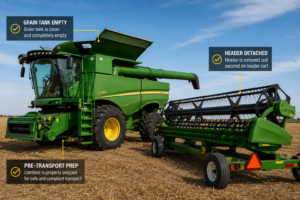
A combine harvester prepared for transport with its header removed and placed on a header cart, while the grain tank is completely empty. Proper pre-shipping preparation helps improve safety, reduce transport width, and ensure compliance during heavy-haul agricultural equipment transportation.
How This Fits Into Total Transport Cost
Prep quality directly affects price. A combine that’s properly drained, header-detached, and dimensionally documented ships faster and with fewer permit complications — both of which keep cost down. For a full breakdown of what goes into a quote, see our Farm Equipment Shipping Cost Guide.
Timing It Around Harvest Season
Combine moves spike twice a year — ahead of harvest, when machines move from storage or dealer lots to the field, and right after, when they head to auction, a new owner, or winter storage. Both windows compress carrier availability and permit processing time at once. If your combine needs to be in position before the first week of harvest, start the prep checklist and book transport at least two to three weeks out.
Get Your Combine Move Quoted
Elite Logistics LLC handles every step of combine harvester transport — route survey, multi-state permit acquisition, pilot car coordination, and DOT-compliant load securement — as part of our farm equipment hauling services. Request a quote and tell us your combine’s make, model, and dimensions to get started.
FAQ SECTION
How long does it take to prepare a combine for transport? Most combines can be prepped — grain tank drained, header detached, platforms lowered — in a few hours. The bigger time factor is permit lead time, which runs 10–15 business days for multi-state oversize moves.
Does the header ship with the combine or separately? It depends on the load and the carrier’s trailer configuration. Many headers ship on a separate header trailer to keep the combine’s transport width within standard oversize limits. Confirm this with your carrier when booking.
What happens if I don’t drain the grain tank before shipping? Residual grain adds unaccounted weight and can shift during transport, which affects axle weight distribution and tie-down integrity. Always drain and sweep the tank before pickup.
Can Elite Logistics LLC handle the permits for me? Yes. Elite Logistics LLC manages the complete permit lifecycle — multi-state acquisition, route pre-surveys, and pilot car coordination — as part of every oversize combine shipment.