
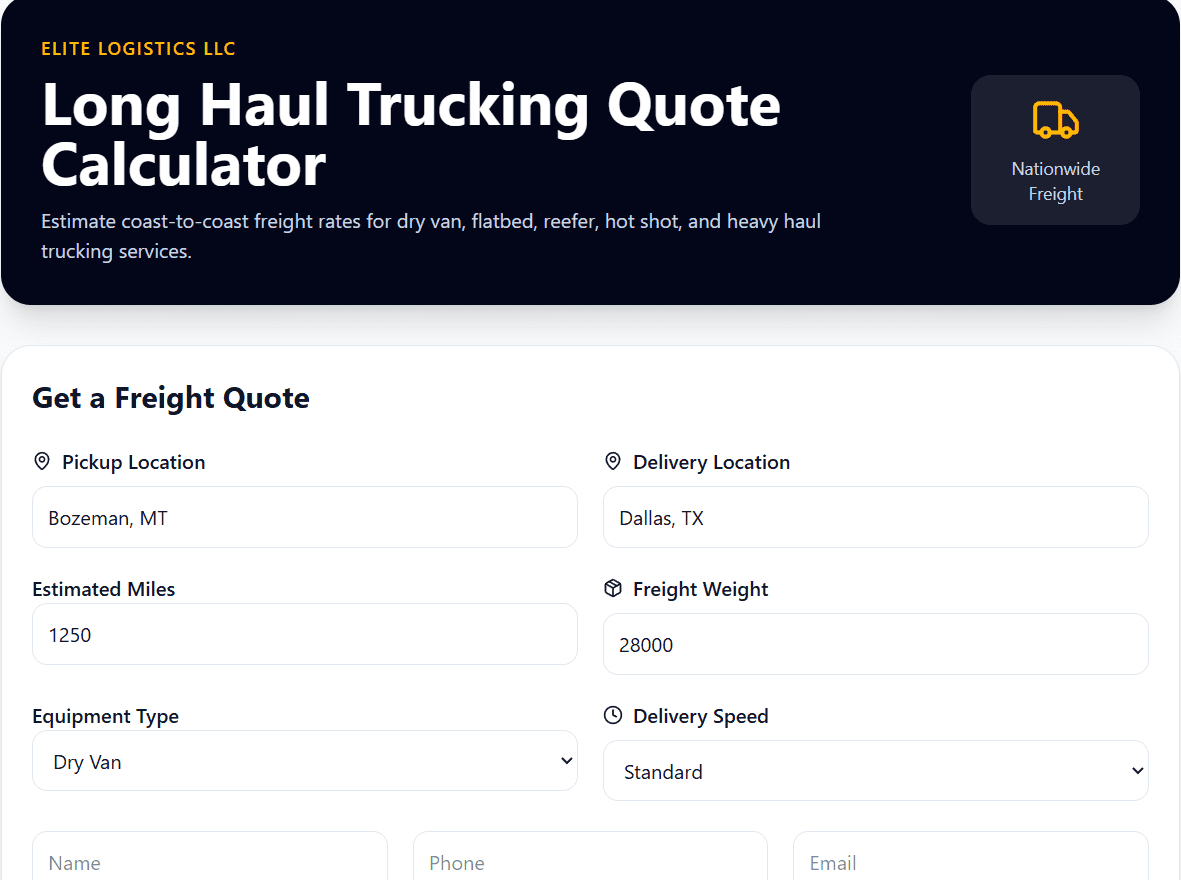
What Does a Long Haul Trucking Quote Actually Include?
What Does a Long Haul Trucking Quote Actually Include? A Line-by-Line Guide

Get a fast freight quote from Elite Logistics LLC — flatbed, heavy haul, hot shot, and specialized trucking across the U.S.
You called three carriers. Three quotes came back — wildly different numbers. Why? Because “the quote” isn’t one number. It’s a stack of line items, and carriers don’t always show all of them up front. Knowing what should be included protects you from sticker shock at invoice time.
Elite Logistics Dispatcher
1. Line Haul Rate
The base charge for moving freight from origin to destination. Usually calculated as cost per mile × total miles, or a flat per-load rate for known lanes. This is the biggest line item and the easiest to compare across carriers — as long as you’re comparing apples to apples.
2. Fuel Surcharge (FSC)
Fuel surcharge adjusts for diesel price fluctuations and is usually shown as a separate line item. Calculated against the DOE national diesel index, FSC moves weekly. A quote that bundles fuel into the line haul rate isn’t necessarily wrong — but ask, because you can’t compare carriers cleanly without separating it out.
3. Accessorial Charges
Anything beyond standard pickup and delivery. Common accessorials:
- Detention — Extra time at pickup or delivery beyond the free window (usually 2 hours), billed hourly
- Layover — Driver forced to wait overnight, typically $250–$400 per day
- Lumper fees — Third-party loading/unloading at warehouses (common in grocery)
- Tarping — Required for flatbed loads needing weather protection
- Driver assist — Driver helps load or unload
- Stop-offs — Multi-stop deliveries beyond the first drop
- Tolls — Some carriers pass through, some include
Quotes should list which accessorials apply and at what rate. “We’ll figure it out” is not an answer.
4. Equipment-Specific Charges
Reefer freight includes fuel for the refrigeration unit (“reefer fuel”). Flatbed includes tarping and securement. Oversized loads include permits and pilot car fees. These should be quoted up front based on freight specs.
5. Insurance and Liability Add-Ons
Standard cargo coverage is built in, but higher-value freight may require additional declared value coverage at a small premium. Ask if your freight value exceeds standard cargo limits.
What Should Appear in Writing
A solid long haul trucking quote includes:
- Origin and destination
- Pickup and delivery dates
- Equipment type and trailer size
- Line haul rate (per mile or flat)
- Fuel surcharge (current rate)
- Accessorial schedule
- Total estimated cost
- Quote validity period (rates change)
- Payment terms
If a carrier won’t put it in writing, walk.
Red Flags in Quotes
- Quote far below market — likely double-brokered or unsustainable
- No fuel surcharge listed — gets added later
- “All-inclusive” with no breakdown — you can’t audit it
- No accessorial rates — every delay becomes a negotiation
- Verbal only — no recourse if billing differs
FAQ
Why are carrier quotes so different for the same load? Equipment availability, lane density, fuel surcharge calculation methods, and accessorial assumptions all vary. The cheapest quote isn’t always the cheapest invoice.
Can I negotiate a long haul trucking quote? On spot freight, yes — especially for return loads or backhauls. On contracted recurring lanes, rates are typically negotiated annually.
How long is a quote valid? Usually 24–72 hours for spot rates; 30+ days for contracted lanes. Fuel surcharges update weekly regardless.
CTA
Want a transparent, itemized quote for your long haul freight? Request one from our team → and we’ll break down every line item before you commit.