
Our Blogs
Explore expert tips, industry updates, and practical advice to make smarter logistics decisions.
FMCSA Compliance & Trucking Regulations
FMCSA Compliance & Trucking Regulations
What every motor carrier, fleet operator, and owner-operator must know to stay audit-ready and legally protected in today’s regulatory environment.

Get a fast freight quote from Elite Logistics LLC — flatbed, heavy haul, hot shot, and specialized trucking across the U.S.
The Federal Motor Carrier Safety Administration sets the legal foundation for every mile traveled by a commercial vehicle in the United States. For carriers operating under their own authority — and for the shippers, brokers, and logistics partners who depend on them — understanding FMCSA compliance isn’t optional. It’s the difference between a thriving operation and a fleet grounded by violations, penalties, or a suspended operating authority. At Elite Logistics LLC, we treat regulatory mastery as a core competency, not an afterthought.
550K+Active Motor Carriers
3.5MCDL Drivers (US)
$16,000Max Per-Violation Penalty
7CSA BASIC Categories
365Days/Year Compliance Required
What Is the FMCSA and Why Does It Govern Your Fleet?
The Federal Motor Carrier Safety Administration was established within the U.S. Department of Transportation in January 2000 with a singular mission: reduce crashes, injuries, and fatalities involving large trucks and buses. The FMCSA accomplishes this by issuing and enforcing the Federal Motor Carrier Safety Regulations (FMCSRs), found in Title 49 of the Code of Federal Regulations, Parts 300–399. These regulations govern virtually every aspect of commercial motor vehicle (CMV) operations — from driver qualifications and vehicle maintenance to cargo securement and hazardous materials handling.
Any entity operating a commercial vehicle with a gross vehicle weight rating (GVWR) exceeding 10,001 pounds in interstate commerce falls under FMCSA jurisdiction. This includes for-hire carriers, private carriers, freight brokers, and leasing companies. Obtaining a USDOT number and, where applicable, an MC number (Motor Carrier operating authority) is the entry point into this regulatory framework — but it is only the beginning of a continuous compliance obligation.
Elite Logistics LLC helps clients navigate this landscape from the moment they apply for operating authority through every subsequent renewal, audit, and regulatory update. Our team monitors FMCSA rulemaking activity so our clients are never caught off-guard by shifting standards.

ELD Mandate: Electronic Logging Device Requirements
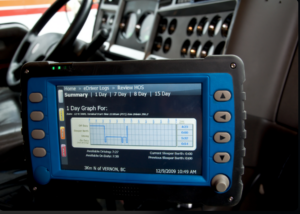
Among the most operationally impactful FMCSA regulations of the past decade, the Electronic Logging Device (ELD) mandate requires that drivers who must maintain Records of Duty Status (RODS) use a certified ELD rather than paper logbooks. Enacted under 49 CFR Part 395, the rule ensures that driving time is recorded automatically and accurately, directly from the commercial motor vehicle’s engine control module (ECM).
An ELD must be registered on the FMCSA’s certified device list and must meet specific technical specifications — including the ability to display graph-grid records, transfer data to enforcement personnel via telematics or a local transfer device, and annotate driving events. Drivers subject to the ELD mandate include property-carrying drivers who operate CMVs in interstate commerce and are required to keep RODS more than eight days out of every 30.
Compliance Insight
Short-haul drivers operating within a 150 air-mile radius and returning to their reporting location within 14 consecutive hours are exempt from ELD requirements, provided they do not exceed the applicable time limits. Documenting short-haul exemption qualification is itself a compliance requirement — one that is frequently overlooked during roadside inspections.
Elite Logistics LLC assists fleets in selecting FMCSA-compliant ELD systems, training drivers on proper use and malfunction protocols, and building internal audit procedures to catch ELD violations before they appear on a driver’s inspection report and damage the carrier’s CSA score.
Hours of Service Rules: Managing Driver Fatigue Legally
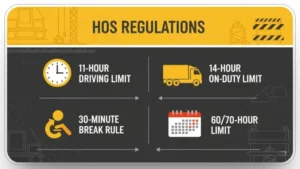
Hours of Service (HOS) regulations, codified in 49 CFR Part 395, are designed to combat driver fatigue — one of the leading causes of large-truck crashes in the United States. For property-carrying drivers, the core limits are clear but nuanced in practice: an 11-hour driving limit following 10 consecutive hours off duty, within a 14-hour on-duty window that cannot be extended by off-duty breaks. A 30-minute rest break is required after eight cumulative hours of driving since the last off-duty or sleeper-berth period of at least 30 minutes.
Key HOS Provisions Every Carrier Must Track
- 60/70-Hour Limit: Drivers may not drive after accumulating 60 on-duty hours in 7 consecutive days, or 70 hours in 8 consecutive days, depending on carrier operating schedule.
- 34-Hour Restart: The weekly on-duty clock resets after a minimum 34 consecutive hours off duty, including two overnight periods between 1:00 and 5:00 a.m. local time.
- Sleeper Berth Provision: Drivers using a sleeper berth may split their required 10-hour off-duty period into a valid combination under 49 CFR 395.1(g)(1).
- Adverse Driving Conditions: Drivers encountering unexpected adverse conditions may extend the driving window by up to two hours beyond the standard 11-hour limit, with notation required in their RODS.
- Short-Haul Exemption: Qualifying short-haul operators may use a 14-hour on-duty window and are exempt from ELD and 30-minute break requirements under specific conditions.
Violations of HOS rules are among the most frequently cited deficiencies during both roadside inspections and FMCSA compliance reviews. Elite Logistics LLC provides carriers with HOS policy templates, driver training materials, and dispatcher guidance to ensure that operational pressures never compromise a driver’s legal status behind the wheel.
CSA Scores: Understanding the FMCSA Safety Measurement System
The Compliance, Safety, Accountability (CSA) program is the FMCSA’s primary tool for prioritizing motor carriers for safety interventions. The Safety Measurement System (SMS) evaluates each carrier across seven Behavior Analysis and Safety Improvement Categories — known as BASICs — using data from roadside inspections, crash reports, and investigations conducted over the previous 24 months. Each BASIC is scored on a percentile basis relative to other carriers in the same peer group, with higher percentile scores indicating greater concern.
The Seven FMCSA CSA BASIC Categories
- Unsafe Driving: Speeding, reckless driving, improper lane changes, and other moving violations.
- Hours of Service Compliance: Logbook violations, ELD non-compliance, and falsification of RODS.
- Driver Fitness: Operating without a valid CDL, medical certificate violations, or disqualified drivers.
- Controlled Substances/Alcohol: Drug or alcohol use or possession violations by drivers.
- Vehicle Maintenance: Out-of-service vehicle defects, brake failures, lighting violations, and inspection deficiencies.
- Hazardous Materials Compliance: Improper placarding, packaging, or handling of HazMat shipments.
- Crash Indicator: History of accidents based on state-reported crash data, weighted by severity.
Carriers whose CSA percentile scores exceed FMCSA intervention thresholds may receive Warning Letters, targeted roadside inspections, or be selected for an on-site compliance review. A poor CSA score also affects a carrier’s ability to secure freight contracts, obtain cargo insurance at favorable rates, and maintain shipper relationships. Elite Logistics LLC provides ongoing SMS monitoring and actionable strategies to dispute inaccurate data, reduce violation exposure, and maintain competitive BASIC scores.
Driver Qualification Files: The Foundation of DOT Compliance
Before a commercial driver operates a vehicle under a carrier’s authority, the carrier must compile and retain a complete Driver Qualification (DQ) File in accordance with 49 CFR Part 391. This is not a one-time administrative task — it is an ongoing obligation with specific retention timelines and update requirements that must survive both internal audits and FMCSA compliance reviews.
A properly maintained DQ file includes the driver’s application for employment, motor vehicle record (MVR) from every state where the driver held a license in the past three years, annual review of driving record, annual driver’s certificate of violations, medical examiner’s certificate (and FMCSA National Registry verification), road test certificate or equivalent, and documentation of entry-level driver training (ELDT) compliance for drivers obtaining or upgrading a CDL after February 7, 2022.
Many carriers discover DQ file deficiencies only when they are already under scrutiny during a compliance review. Elite Logistics LLC conducts proactive DQ file audits, identifies gaps before they become violations, and implements systematic file management processes that scale with fleet growth.
Drug & Alcohol Testing: 49 CFR Part 382 Compliance
Commercial drivers operating vehicles requiring a CDL are subject to mandatory federal drug and alcohol testing under FMCSA regulations at 49 CFR Part 382. Carriers must implement a compliant testing program administered through a DOT-regulated laboratory and a Medical Review Officer (MRO). Testing is required at pre-employment, post-accident, reasonable suspicion, random, return-to-duty, and follow-up stages.
FMCSA’s random drug testing rate is set annually — currently at 50% of the average number of driver positions for controlled substances and 10% for alcohol. Carriers must participate in a DOT-compliant Consortium/Third-Party Administrator (C/TPA) if they do not administer their own stand-alone testing program. Failure to maintain a compliant program — including supervisor reasonable-suspicion training — is a serious FMCSA violation that can trigger a compliance review and civil penalties.
Elite Logistics LLC helps carriers enroll in qualified C/TPA programs, document supervisor training, manage the clearinghouse query process under 49 CFR Part 382 Subpart G, and respond to positive test results with appropriate return-to-duty protocols.
Vehicle Maintenance Programs & Pre-Trip Inspections
Under 49 CFR Part 396, motor carriers are responsible for systematically inspecting, repairing, and maintaining every vehicle in their fleet. The regulation requires that carriers develop and implement a preventive maintenance (PM) schedule, retain inspection, repair, and maintenance records for prescribed periods, and ensure that every driver completes a Driver Vehicle Inspection Report (DVIR) at the end of each duty tour, noting any defects that may affect the vehicle’s safe operation or that could result in a mechanical failure.
Annual inspections — meeting or exceeding the standards in 49 CFR Part 396 Appendix G — must be performed and documented for each vehicle. The inspection sticker or documentation must be carried in the vehicle during roadside inspections. Out-of-service vehicle defects represent one of the highest-frequency violations recorded in the FMCSA SMS Vehicle Maintenance BASIC, making a robust PM program one of the most direct investments a carrier can make in protecting its CSA score.
IFTA, IRP & Operating Authority: The Licensing Layer
Beyond safety regulations, carriers operating interstate routes must comply with the International Fuel Tax Agreement (IFTA) for fuel tax reporting and the International Registration Plan (IRP) for apportioned vehicle registration. IFTA requires carriers to file quarterly fuel tax returns reporting miles traveled and fuel purchased in each member jurisdiction. Failure to maintain accurate mileage records — or to file on time — results in penalties, interest charges, and potential license revocation.
Operating authority through the FMCSA requires that for-hire carriers maintain federally mandated insurance minimums: $750,000 in public liability for most property carriers, with higher limits for HazMat operations. Continuous proof of insurance must be on file with the FMCSA through a Form BMC-91 or BMC-91X filing by the carrier’s insurer. A lapse in insurance filing automatically revokes operating authority — a consequence that can strand freight and devastate customer relationships overnight. Elite Logistics LLC monitors insurance filings and renewal deadlines as part of its comprehensive compliance management services.

FMCSA Compliance Reviews: What to Expect and How to Prepare
A DOT Compliance Review (CR) is an on-site examination of a motor carrier’s operations, records, and safety management practices. The FMCSA may initiate a compliance review based on poor CSA scores, a complaint, a serious crash, or as part of a new entrant safety audit (required within the first 12 months of a new carrier’s operation). During a compliance review, investigators examine driver qualification files, HOS records, vehicle maintenance documentation, accident registers, drug and alcohol testing records, and hazardous materials compliance where applicable.
Carriers receive one of three ratings following a compliance review: Satisfactory, Conditional, or Unsatisfactory. An Unsatisfactory rating, if not corrected within 45–60 days, results in an order to cease commercial motor vehicle operations. Even a Conditional rating places a carrier on FMCSA’s watch list and signals to shippers and brokers a heightened level of risk.
Elite Logistics Compliance Advantage
Elite Logistics LLC conducts mock compliance reviews for clients — systematically examining every document category an FMCSA investigator would review, identifying deficiencies, and implementing corrective action plans before a formal audit ever occurs. Carriers who undergo proactive internal audits consistently outperform industry averages in FMCSA compliance review outcomes.
Elite Logistics LLC: Your FMCSA Compliance Partner
Regulatory compliance in the commercial trucking industry is not a static achievement — it is a continuous operational discipline that requires dedicated expertise, current regulatory knowledge, and systematic execution. The landscape evolves with each FMCSA rulemaking cycle, and carriers who treat compliance as a low-priority administrative function consistently bear the highest costs: civil penalties, elevated insurance premiums, poor CSA scores, lost freight contracts, and, in the worst cases, revoked operating authority.
Elite Logistics LLC was built to eliminate that exposure. We serve as an outsourced compliance department for carriers of all sizes, providing the depth of regulatory expertise previously available only to large fleets with in-house safety departments. Our services encompass the full FMCSA regulatory spectrum — from initial operating authority applications and new entrant audit preparation to ongoing DQ file management, ELD program oversight, drug and alcohol testing program administration, CSA score monitoring and DataQ dispute resolution, vehicle maintenance compliance, and IFTA/IRP management.
Every fleet we serve benefits from a compliance infrastructure designed to withstand scrutiny — from the most routine roadside inspection to a formal FMCSA compliance review. That is the Elite Logistics LLC standard, and it is the standard your operation deserves.
Ready to Fortify Your FMCSA Compliance Program?
Contact Elite Logistics LLC today for a complimentary compliance assessment. We’ll identify your current risk exposure and build a roadmap to full regulatory confidence.